
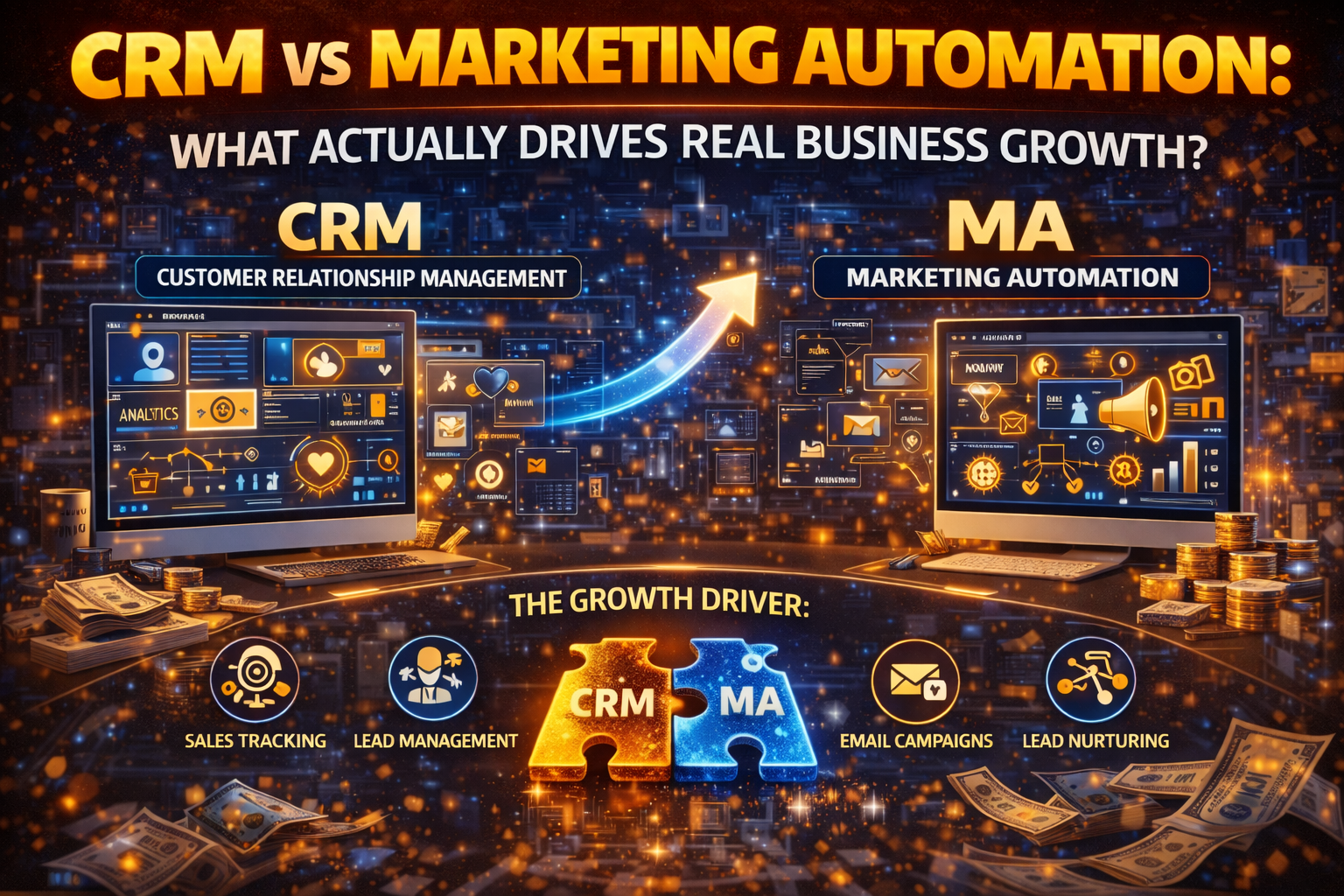
Explore the key differences between CRM vs Marketing Automation and discover which one truly drives growth. Learn how to combine both for maximum results in 2026.
Table of Contents
Introduction
In today’s digital-first business environment, companies are constantly searching for tools that can accelerate growth, improve customer relationships, and increase revenue. Two of the most commonly used systems are CRM (Customer Relationship Management) and Marketing Automation.
But here’s the big question: CRM vs Marketing Automation—what actually drives growth?
Many businesses treat them as interchangeable, while others invest heavily in one and ignore the other. The truth is more nuanced.
In this blog, we’ll break down the differences, strengths, and real impact of CRM and marketing automation—and help you understand how to use them strategically for sustainable growth.
What is CRM?
CRM (Customer Relationship Management) is a system designed to manage and analyze customer interactions throughout the customer lifecycle.
It helps businesses:
- Store customer data
- Track communication
- Manage sales pipelines
- Improve customer relationships
👉 Learn more about CRM:
https://www.salesforce.com/crm/what-is-crm/
What is Marketing Automation?
Marketing Automation refers to software that automates marketing tasks and workflows.
It enables businesses to:
- Run email campaigns
- Nurture leads
- Segment audiences
- Track marketing performance
👉 Learn about marketing automation:
https://www.hubspot.com/products/marketing/marketing-automation
CRM vs Marketing Automation: Core Differences
Focus Area
- CRM focuses on sales and relationship management
- Marketing Automation focuses on lead generation and nurturing
Primary Users
- CRM is mainly used by sales teams
- Marketing Automation is used by marketing teams
Key Function
- CRM tracks and manages customers
- Marketing Automation engages and nurtures leads
Data Usage
- CRM uses historical and interaction data
- Marketing Automation uses behavioral and campaign data
👉 Explore CRM comparisons:
https://www.g2.com/categories/crm
How CRM Drives Growth
CRM systems contribute to growth by strengthening customer relationships.
Improved Sales Pipeline Management
CRM helps track every stage of the sales funnel, ensuring no opportunity is missed.
Better Customer Retention
By storing interaction history, CRM enables personalized communication.
👉 Learn about customer retention:
https://hbr.org/2014/10/the-value-of-keeping-the-right-customers
Data-Driven Sales Decisions
CRM provides insights into:
- Customer behavior
- Sales performance
- Conversion rates
Enhanced Customer Experience
Consistent and personalized interactions build trust and loyalty.
How Marketing Automation Drives Growth
Marketing Automation focuses on attracting and nurturing leads.
Lead Generation at Scale
Automated campaigns help businesses reach a larger audience efficiently.
Lead Nurturing
Marketing automation keeps leads engaged through:
- Email sequences
- Content delivery
- Retargeting
👉 Learn about lead nurturing:
https://mailchimp.com/resources/lead-nurturing/
Personalized Marketing Campaigns
Behavior-based segmentation allows targeted messaging.
Improved Marketing ROI
Automation reduces manual effort and increases efficiency.
The Real Truth: Growth Comes from Integration
The debate of CRM vs Marketing Automation often misses a key point—they are not competitors, they are complementary systems.
When combined, they create a powerful growth engine.
How Integration Works
- Marketing Automation generates and nurtures leads
- CRM converts leads into customers
- Both systems share data for better insights
👉 Learn about CRM integration:
https://www.oracle.com/cx/what-is-crm/crm-integration/
Example Workflow
- A user visits your website
- Marketing Automation tracks behavior and sends emails
- The lead becomes qualified
- CRM captures and tracks the lead
- Sales team closes the deal
Benefits of Combining CRM and Marketing Automation
Unified Customer View
All data is centralized, providing a 360-degree view of the customer.
Better Alignment Between Sales and Marketing
Teams work together with shared data and goals.
Higher Conversion Rates
Better lead nurturing leads to higher-quality prospects.
Improved Customer Experience
Consistent messaging across all touchpoints.
Common Mistakes Businesses Make
Relying Only on One System
Using only CRM or only marketing automation limits growth potential.
Poor Integration
Disconnected systems lead to data silos and inefficiencies.
Ignoring Data Quality
Bad data reduces the effectiveness of both systems.
Lack of Strategy
Tools alone don’t drive growth—strategy does.
Which One Should You Choose?
The answer depends on your business stage:
- Early-stage startups: Start with CRM to manage relationships
- Growing businesses: Add marketing automation for scaling
- Established companies: Integrate both systems
👉 Compare tools:
https://www.capterra.com/crm-software/
Future of CRM and Marketing Automation
Looking ahead, both systems are evolving with:
AI-Driven Automation
Predict customer behavior and automate decisions.
Hyper-Personalization
Deliver tailored experiences in real time.
Real-Time Data Integration
Instant insights across platforms.
Autonomous Systems
Self-operating CRM and marketing workflows.
Conclusion
So, CRM vs Marketing Automation—what actually drives growth?
The real answer is: both, when used together.
CRM builds relationships and closes deals. Marketing automation attracts and nurtures leads. Individually, they are powerful—but together, they are transformative.
Businesses that integrate these systems effectively will:
- Improve efficiency
- Increase conversions
- Deliver better customer experiences
- Achieve sustainable growth
In 2026, growth is not about choosing between tools—it’s about creating a connected ecosystem.
Learn everything about GDPR and CRM, including key compliance rules, common mistakes, and best practices to protect customer data and build trust in 2026.
