
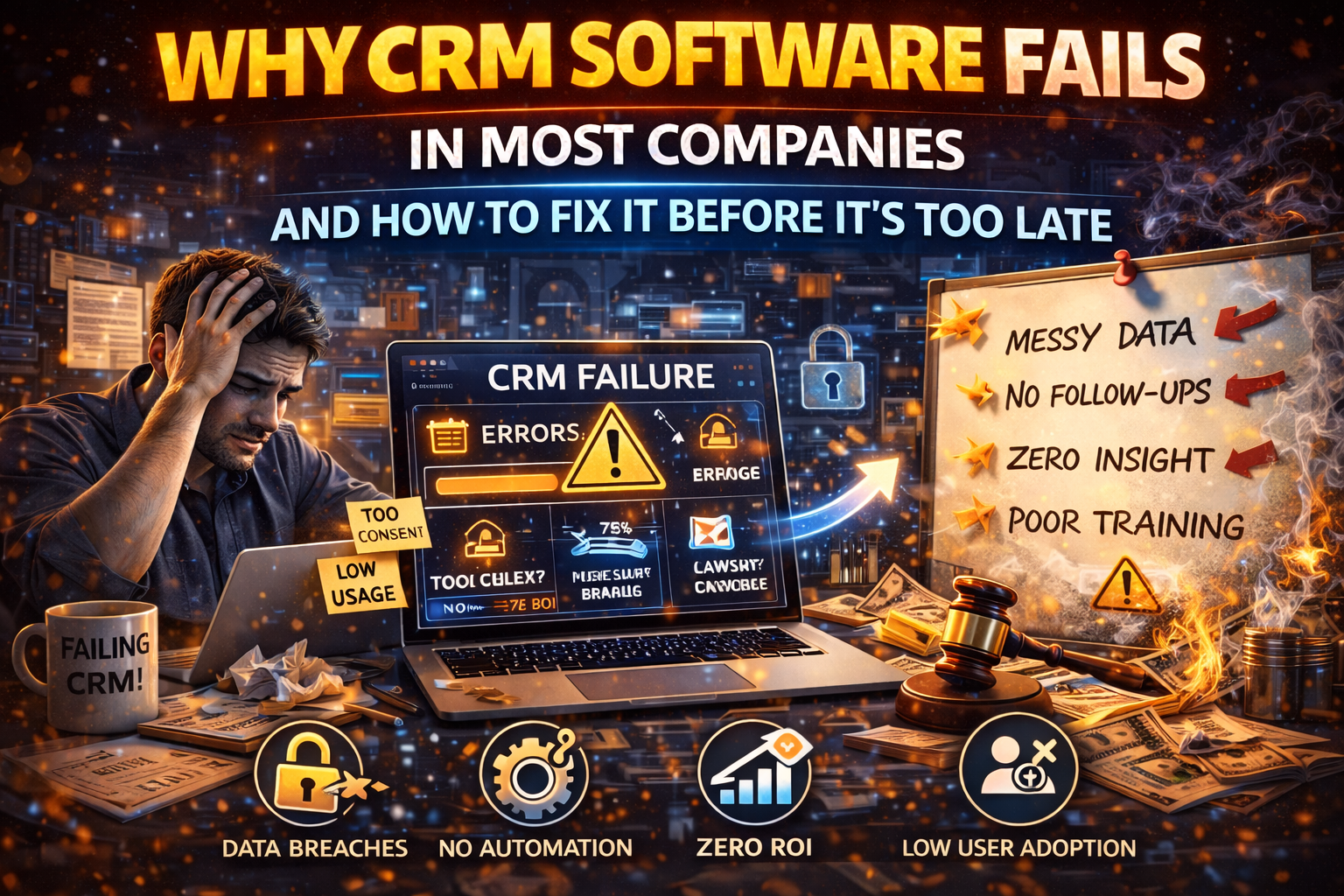
Discover why CRM Software fails in most companies and learn how to avoid common mistakes. Improve adoption, strategy, and ROI with smarter CRM implementation.
Table of Contents
Introduction
CRM Software is often seen as a powerful solution for managing customer relationships, increasing sales, and improving efficiency. Yet, despite its potential, a large number of companies fail to get real value from their CRM systems.
This raises an important question: why does CRM Software fail so often?
The problem isn’t the technology—it’s how businesses use it.
In this blog, we’ll uncover the real reasons behind CRM failures and provide actionable insights to help you avoid these pitfalls and maximize your CRM investment.
What is CRM Software and Why It Matters
CRM Software helps businesses manage interactions with customers, track leads, and streamline processes.
It enables companies to:
- Organize customer data
- Automate workflows
- Improve communication
- Enhance customer experience
👉 Learn more about CRM basics:
https://www.salesforce.com/crm/what-is-crm/
👉 Explore CRM tools:
https://www.hubspot.com/products/crm
When used correctly, CRM Software can become a growth engine. But when misused, it becomes a costly burden.
Why CRM Software Fails in Most Companies
Lack of Clear Strategy
One of the biggest reasons CRM Software fails is the absence of a clear strategy.
Many companies implement CRM without defining:
- Goals
- Use cases
- Success metrics
👉 Learn about strategic planning:
https://hbr.org/2011/01/what-is-strategy
Result: The CRM becomes a tool without direction.
Poor User Adoption
Even the best CRM Software is useless if employees don’t use it.
Common reasons include:
- Complex interfaces
- Lack of training
- Resistance to change
👉 Learn about CRM adoption:
https://www.capterra.com/resources/crm-adoption/
Solution: Focus on usability and proper onboarding.
Overcomplicated Systems
Many organizations choose feature-heavy CRM platforms that are difficult to manage.
This leads to:
- Confusion
- Low productivity
- Frustration
Solution: Start simple and scale gradually.
Poor Data Quality
CRM Software depends on accurate data.
Common issues:
- Duplicate records
- Missing information
- Outdated data
👉 Learn about data management:
https://www.ibm.com/topics/data-management
Impact: Bad data leads to poor decisions.
Lack of Integration
CRM systems often fail when they don’t integrate with other tools such as:
- Marketing platforms
- Email systems
- Analytics tools
👉 Explore system integration:
https://www.oracle.com/integration/what-is-system-integration/
Result: Data silos and inefficiencies.
Ignoring Customer Experience
Many companies focus only on sales and neglect customer relationships.
This leads to:
- Poor engagement
- Low retention
- Negative feedback
👉 Learn about customer experience:
https://www.zendesk.com/blog/customer-experience/
Insufficient Training and Support
Employees need proper training to use CRM Software effectively.
Without it:
- Features remain unused
- Errors increase
- Productivity decreases
Lack of Leadership Support
CRM success requires strong leadership.
Without executive support:
- Teams lack motivation
- Implementation fails
- Adoption drops
Unrealistic Expectations
Some companies expect instant results from CRM Software.
In reality:
- CRM requires time
- Data needs to build up
- Processes must be refined
Solution: Be patient and focus on long-term results.
Key Signs Your CRM Software is Failing
- Low usage by team members
- Inconsistent or messy data
- Missed follow-ups
- Poor sales performance
- Lack of actionable insights
If you notice these signs, your CRM strategy needs improvement.
How to Fix CRM Software Failures
Define Clear Objectives
Start by answering:
- What do you want to achieve with CRM?
- How will success be measured?
Choose the Right CRM Tool
Select software that matches your business needs and complexity.
👉 Compare CRM tools:
https://www.g2.com/categories/crm
Simplify the System
Avoid unnecessary features. Focus on core functionalities first.
Invest in Training
Ensure your team understands:
- How to use the CRM
- Why it matters
Maintain Data Quality
Regularly clean and update your CRM data.
Leverage Automation
Automate repetitive tasks such as:
- Follow-ups
- Email campaigns
- Task reminders
Integrate with Other Tools
Ensure your CRM connects seamlessly with your existing systems.
Monitor and Optimize
Continuously track performance and improve processes.
👉 Learn about performance optimization:
https://analytics.google.com/
Future of CRM Software
CRM Software is evolving rapidly with new technologies:
AI-Powered CRM
Predict customer behavior and automate decisions.
Hyper-Personalization
Deliver tailored experiences at scale.
Real-Time Insights
Instant data analysis for faster decisions.
No-Code Platforms
Simplify customization without technical expertise.
Conclusion
CRM Software doesn’t fail because it lacks capability—it fails because of poor implementation and strategy.
By addressing common issues such as:
- Lack of strategy
- Poor adoption
- Data problems
- Overcomplexity
businesses can unlock the true potential of CRM.
The key takeaway is simple: CRM is not just a tool—it’s a system that requires planning, discipline, and continuous improvement.
When used correctly, CRM Software can transform your business. When used incorrectly, it becomes an expensive mistake.
Is your CRM legal? Discover the most common data protection mistakes businesses make and learn how to ensure compliance, protect customer data, and avoid legal risks.
