
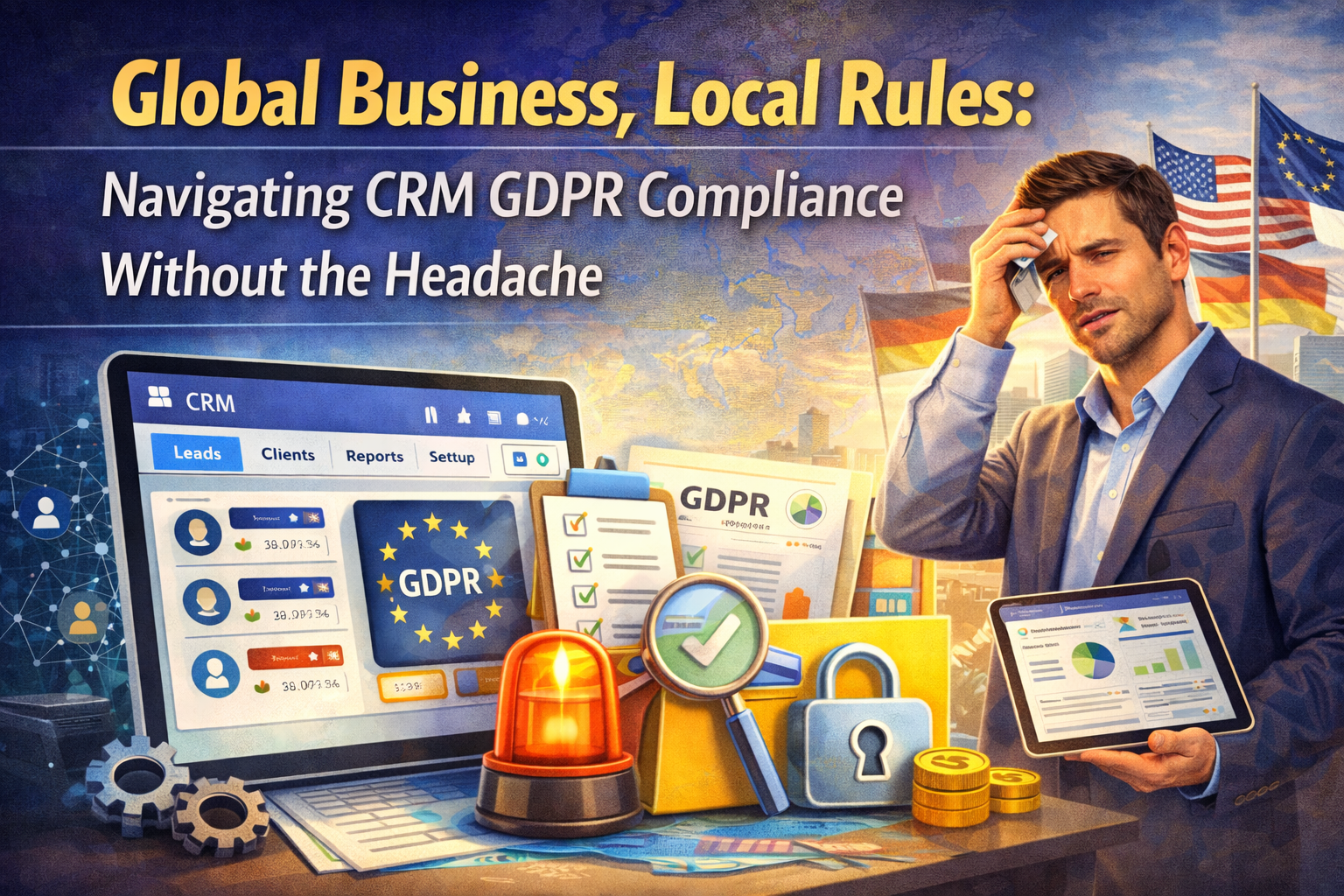
Scaling across borders? Learn how to manage CRM GDPR Compliance for international operations. Stay legal, protect data, and build trust with your global audience.
Table of Contents
If you’ve ever sat in a meeting discussing international expansion, you know the excitement is usually followed by a wave of cold sweat the moment someone mentions data privacy. Scaling your business across borders is a massive achievement, but it also means you’re suddenly dancing with a dozen different legal frameworks. At the heart of this storm is your database.
Managing CRM GDPR Compliance is often viewed as a purely technical hurdle, but I like to think of it as a matter of digital etiquette. If you’re entering someone’s home—or in this case, their inbox—you need to follow their house rules. The General Data Protection Regulation (GDPR) isn’t just a European law; it is the global gold standard for how we treat people’s information. If your CRM isn’t up to code, you aren’t just risking a fine; you’re risking the very trust that makes international growth possible.
The Reality of Data Without Borders
The tricky part about the modern business world is that data doesn’t care about physical maps. You might be sitting in an office in New York or Mumbai, but if you have a single customer residing in the European Union, you are officially on the hook for CRM GDPR Compliance.
Many business owners mistakenly believe that because they don’t have a physical office in Europe, the rules don’t apply. That is a dangerous gamble. The law follows the person, not the company. This means your CRM needs to be intelligent enough to distinguish between a lead in California and a lead in Germany, applying the correct privacy logic to each.
Seven Core Principles Every Manager Needs to Know
To stay on the right side of the law, your CRM GDPR Compliance strategy needs to be built on a foundation of transparency. It’s not just about ticking boxes; it’s about a mindset shift.
- Lawfulness, Fairness, and Transparency: You must have a legal reason to hold someone’s data, and you must tell them exactly what you’re doing with it.
- Purpose Limitation: Don’t collect data “just in case.” If you asked for an email to send a newsletter, don’t use it to profile their credit score.
- Data Minimization: Only ask for what you actually need. If you’re selling digital ebooks, do you really need their home address?
- Accuracy: Keep it clean. If a customer updates their info, your CRM must reflect that change across all integrated platforms.
- Storage Limitation: Data shouldn’t live in your system forever. Have a clear deletion policy for inactive leads.
- Integrity and Confidentiality: This is where cybersecurity comes in. Use encryption and strict access controls.
- Accountability: You need to be able to prove you are following the rules. Documentation is your best friend here.
Handling the “Right to be Forgotten”
One of the biggest shifts in CRM GDPR Compliance is the “Right to Erasure.” In the old days, “unsubscribing” just meant someone stopped getting emails. Under GDPR, a customer can demand that you delete every trace of them from your servers.
This is harder than it sounds. If your CRM is connected to your accounting software, your customer support desk, and your email marketing tool, a deletion request can trigger a logistical nightmare. A compliant CRM must have a “kill switch” functionality that ensures when a record is wiped, it doesn’t leave “ghost” data in other connected apps. This is why data governance is so crucial for international enterprises.
International Data Transfers: Beyond the EU
When you operate internationally, your data often travels. Maybe your CRM servers are in the US, but your sales team is in the UK, and your customers are in France. This is known as a cross-border data transfer.
To maintain CRM GDPR Compliance, you can’t just move data wherever you want. You need to ensure the destination country has “adequate” protection levels. If it doesn’t, you’ll likely need to implement Standard Contractual Clauses (SCCs). These are essentially legal promises that you will treat the data with GDPR-level care, no matter where in the world it is stored. For a deeper look at the legalities, the European Commission’s official page on data transfers is the definitive resource.
The Role of Consent Management
Gone are the days of the pre-checked “Yes, send me everything” box. Under CRM GDPR Compliance rules, consent must be freely given, specific, and informed. It must also be as easy to withdraw as it was to give.
If your CRM doesn’t track how and when someone gave consent, you are at risk. I’ve seen companies get hit with heavy penalties simply because they couldn’t produce a timestamped log of a user’s opt-in. Your system should act as a ledger of trust, recording every time a user grants or revokes permission to use their data.
Appointing a Data Protection Officer (DPO)
If you’re processing a high volume of international data, you might be legally required to appoint a Data Protection Officer. Even if you aren’t legally mandated, having a “privacy champion” on your team is a smart move for CRM GDPR Compliance.
This person acts as the bridge between the legal team and the IT department. They ensure that when the marketing team wants to run a new “retargeting” campaign, it doesn’t accidentally violate privacy by design principles. It’s about having a voice in the room that asks, “Is this legal?” before you spend thousands on a campaign. You can find more about the DPO role on Wikipedia’s page for Data Protection Officer.
Security is the Silent Partner of Compliance
You can have the best privacy policy in the world, but if your database gets hacked, your CRM GDPR Compliance is worth zero. GDPR specifically mandates that companies implement “appropriate technical and organizational measures” to protect data.
During your routine security audits, you should be looking for:
- End-to-end encryption: Both for data at rest and in transit.
- Multi-factor authentication: Ensuring that a stolen password doesn’t lead to a data breach.
- Access Logs: Knowing exactly who accessed which record and why.
The Impact of Non-Compliance on International Growth
Let’s be blunt: the fines are eye-watering. We’re talking up to €20 million or 4% of your total global turnover—whichever is higher. For most businesses, that isn’t just a “cost of doing business” fine; it’s a “close the doors” fine.
But beyond the money, it’s the reputational hit. In a world where consumers are increasingly wary of how their data is used, being labeled as “untrustworthy” can kill your expansion plans faster than a bad product-market fit. Staying on top of CRM GDPR Compliance is essentially an insurance policy for your brand’s reputation.
Best Practices for International Teams
If your team is spread across the globe, consistency is your biggest challenge. A salesperson in a country with lax privacy laws might not realize that their “cold outreach” strategy is illegal when targeting an EU prospect.
- Centralized Training: Ensure everyone understands the basics of CRM GDPR Compliance.
- Geographic Tagging: Use your CRM to tag leads by their location so the system can automatically apply the correct privacy rules.
- Regular Database Cleaning: If a lead hasn’t engaged in two years, delete them. It reduces your “surface area” of risk.
Summary of the Compliance Journey
Achieving CRM GDPR Compliance for international operations is a marathon, not a sprint. It requires constant monitoring and a willingness to update your processes as the law evolves. But it also forces you to have a cleaner, more organized, and more effective database. When you only talk to people who actually want to hear from you, your conversion rates naturally go up.
FAQ Section
1. Does GDPR apply if my business is based outside of Europe? Yes. If you offer goods or services to people in the EU, or if you monitor the behavior of people in the EU (like using tracking cookies), you must maintain CRM GDPR Compliance. The location of your headquarters does not matter.
2. What is the difference between a Data Controller and a Data Processor? A Data Controller (usually your business) decides why and how personal data is processed. A Data Processor (like your CRM software provider) processes that data on your behalf. Under GDPR, both have significant legal responsibilities.
3. Can I still use my CRM for cold emailing in Europe? It’s tricky. GDPR generally requires a “lawful basis” for processing. While “legitimate interest” is sometimes used for B2B outreach, many EU countries have even stricter local laws (like the ePrivacy Directive) that require prior opt-in consent for email marketing.
4. How does CRM GDPR Compliance affect my data backups? Your backups must be as secure as your live database. Furthermore, if a user exercises their “right to be forgotten,” you must ensure that if you ever restore a backup, that deleted user isn’t accidentally “resurrected” into your live system.
5. Is the UK GDPR different from the EU GDPR? Following Brexit, the UK adopted its own version known as the UK GDPR. Currently, they are very similar, but they are two distinct legal regimes. If you operate in both the UK and the EU, you need to ensure your CRM GDPR Compliance covers both.
Conclusion
Navigating the world of international data privacy can feel like walking through a minefield, but it doesn’t have to be. By treating CRM GDPR Compliance as a core business value rather than a legal chore, you build a foundation of transparency that resonates with customers everywhere.
