
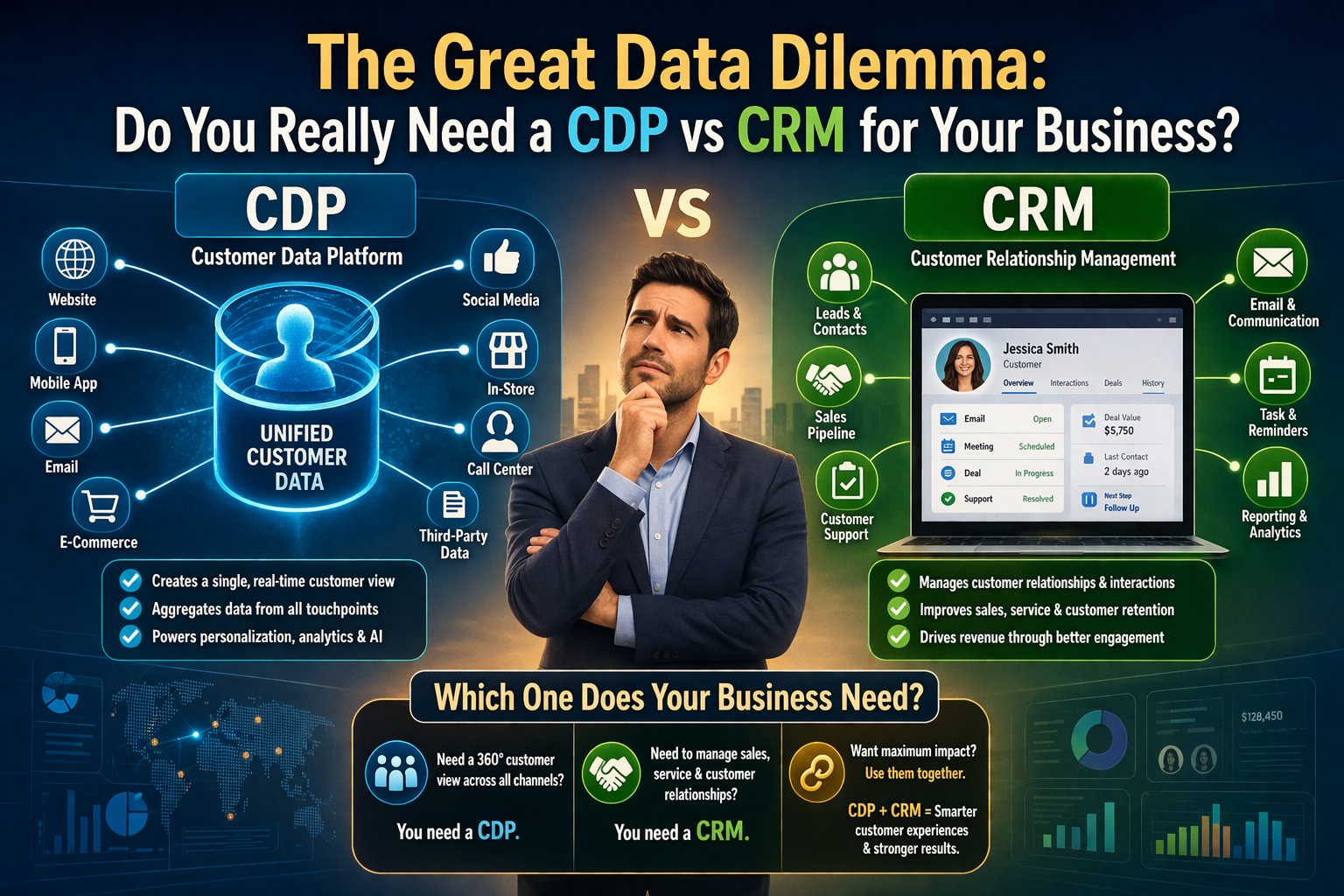
Confused about CDP vs CRM? Discover the key differences between a Customer Data Platform and a CRM to help you manage unified customer profiles and boost ROI.
Table of Contents
I’ve spent countless hours in boardrooms where marketing directors and sales VPs are practically pulling their hair out over the same issue: “Why don’t we know who our customers actually are?” It sounds like a simple question, but in a world where a single buyer might interact with your brand on Instagram, click an email, visit your website three times, and then call a sales rep, the data gets messy fast. Usually, this is the exact moment someone throws out a new acronym and asks if we need a CDP vs CRM to fix the leak.
If you are feeling overwhelmed by the alphabet soup of enterprise tech, you aren’t alone. For years, the CRM was the undisputed king of the castle. But as our digital footprints have grown from simple breadcrumbs into massive data trails, a new contender has entered the ring. Choosing between a CDP vs CRM isn’t just about picking a software; it’s about deciding how you want to see your customers—as a list of sales opportunities or as a living, breathing set of behaviors.
The Traditional Titan: What is a CRM, Really?
Let’s start with the old reliable. A Customer Relationship Management (CRM) system is essentially the digital heartbeat of your sales and support teams. It’s where your reps log calls, track emails, and move deals through a pipeline. If you have a person-to-person sales model, your CRM is your best friend.
When people compare a CDP vs CRM, they often forget that a CRM is primarily designed for manual data entry or direct integrations. It’s built to help humans manage relationships with other humans. It’s perfect for knowing that “John Smith at Company X prefers a phone call on Tuesdays,” but it starts to struggle when you ask it to track every single anonymous ad click John made before he ever told you his name.
The New Frontier: Understanding the CDP
A Customer Data Platform (CDP) is a different beast entirely. While a CRM focuses on the relationship, a CDP focuses on the data itself. Its job is to ingest massive amounts of raw information from every possible source—social media, website cookies, point-of-sale systems, and even your CRM—to create a “Golden Record.”
The debate of CDP vs CRM often hinges on the concept of identity resolution. A CDP can take a random IP address from a Monday morning and a mobile device ID from a Friday afternoon and realize they belong to the same person. It’s an automated, technical powerhouse that works in the background to build a 360-degree view of the customer without a sales rep ever lifting a finger.
Key Differences: CDP vs CRM at a Glance
To make an informed choice, you have to understand the “soul” of each system. They might look similar on a marketing brochure, but under the hood, they are built for entirely different purposes.
- Data Sources: A CRM mostly handles “first-party” data—info you’ve gathered directly through interactions. A CDP handles everything from first-party to third-party data, including anonymous behavioral signals.
- User Base: Sales and customer success teams live in the CRM. The marketing and data science teams are the ones who usually push for a CDP.
- Primary Function: In the world of CDP vs CRM, the CRM is for engagement. The CDP is for analysis and segmentation.
- Real-time Capabilities: CRMs are updated when a human types something in. CDPs are designed for real-time data streaming and instant profile updates.
Why a CRM Isn’t Enough for Modern Marketing
I’ve seen many growing companies try to force their CRM to act like a data warehouse. It’s like trying to use a screwdriver to hammer in a nail—it might work eventually, but it’s going to be painful. CRMs are not built to handle the “noise” of modern digital marketing. If you try to pipe every single website click into a CRM contact record, the system will lag, and your sales reps will be buried in useless data.
This is where the CDP vs CRM distinction becomes vital. You want your sales reps to see the “signal”—the real conversations. You want your marketing automation to handle the “noise.” A CDP can process millions of events and only push the most important “sales-ready” triggers into your CRM. According to the Customer Data Platform Institute, a true CDP must be a persistent, unified database that is accessible to other systems.
The Hidden Power of Unified Customer Profiles
The “holy grail” of modern business is the unified profile. Imagine a customer calls your support line, and the agent can immediately see that the customer was just browsing a specific product on the website ten minutes ago. That level of insight is only possible when you understand the synergy of CDP vs CRM architectures.
By using a CDP to aggregate data and then “feeding” that cleaned-up info into the CRM, you give your team superpowers. You aren’t just guessing what the customer wants; you have a data-backed roadmap of their entire journey. This leads to higher customer lifetime value and much better retention rates because your communication feels personalized, not generic.
Managing Data Privacy and Compliance
We can’t talk about data without talking about the legal side of things. With regulations like GDPR and CCPA, how you store and “unify” data is now a high-stakes legal issue. A major factor in the CDP vs CRM decision is how each handles consent.
CDPs are often better at managing “consent at scale.” Because they track the source of every data point, they can automatically “forget” a user across all systems if a request is made. CRMs, being more manual, often leave “ghost” records in notes or old email threads. For a deeper look at the legalities of data management, Wikipedia’s page on Data Governance is a great resource for understanding your responsibilities.
Cost and Implementation: The Elephant in the Room
I’ll be honest: a CDP is usually a much larger investment than a CRM. It requires data engineers, clear strategy, and a significant budget. If you are a small business with a few hundred customers, the CDP vs CRM debate is easy—you just need a CRM.
However, once you are spending six figures on digital ads and have a complex multi-channel strategy, the “cost of not knowing” your customers becomes higher than the cost of the CDP. You start wasting money on ads for people who have already bought the product, simply because your systems don’t talk to each other. In that scenario, the ROI on a CDP is massive.
Can One Replace the Other?
The short answer is: No. In the battle of CDP vs CRM, they aren’t actually enemies—they are teammates. You don’t replace your CRM with a CDP; you use the CDP to make your CRM smarter. Think of the CDP as the “brain” that collects the memories and the CRM as the “mouth” that speaks to the customer.
Trying to use a CDP as a CRM is a mistake because CDPs aren’t built for task management or notes. Conversely, trying to use a CRM as a CDP will lead to data fragmentation and a frustrated marketing team. To learn more about how these tech stacks are evolving, check out the insights from Gartner on Customer Experience.
Strategic Questions to Ask Your Team
Before you sign a contract for a new platform, sit your leads down and ask the following:
- Where does our data come from? If it’s mostly offline or direct sales, stick to your CRM. If it’s thousands of web hits a day, look into a CDP.
- Who is the primary user? If it’s a sales rep, the CRM is king. If it’s an automated marketing engine, you need a CDP.
- Do we have “siloed” data? If your support team doesn’t know what your marketing team is doing, the CDP vs CRM integration is your likely solution.
The Future of Customer Data
As we move toward a “cookieless” world, first-party data is becoming the only reliable currency. This makes the CDP vs CRM conversation more relevant than ever. Companies that can unify their own data without relying on third-party trackers will win.
Whether you choose to double down on your CRM or invest in a shiny new CDP, the goal remains the same: treat the customer like an individual, not a row in a spreadsheet. The tech is just a tool to help you achieve that human connection at scale.
FAQ Section
1. Is a CDP just a fancy CRM? Not at all. While both manage customer info, the CDP vs CRM difference lies in the source and type of data. A CRM is for managing human-led relationships, whereas a CDP is for unifying high-volume, automated technical data from dozens of sources.
2. At what size does a company need a CDP? There is no “magic number” of employees, but usually, once you have millions of data points (clicks, views, transactions) and multiple marketing channels, a CRM becomes insufficient for data unification.
3. Does a CDP require a lot of IT support? Yes. Unlike a CRM that a sales manager can often set up, a CDP usually requires data engineers to properly map the “schema” and ensure the data is flowing correctly from your website and apps.
4. How does the CDP vs CRM choice affect GDPR? A CDP can actually make GDPR compliance easier by providing a single point to manage “Right to be Forgotten” requests across your entire tech stack, whereas a CRM might leave fragmented data in various sub-menus.
5. Can a CRM do any identity resolution? Some modern CRMs have basic “de-duplication” features to merge two contacts with the same email, but they cannot handle the complex, multi-device “probabilistic” matching that a CDP is built for.
Conclusion
Navigating the CDP vs CRM landscape can feel like a daunting task, but it’s a sign that your business is maturing. If you are struggling with “blind spots” in your customer journey, it’s probably time to look beyond the CRM.
