
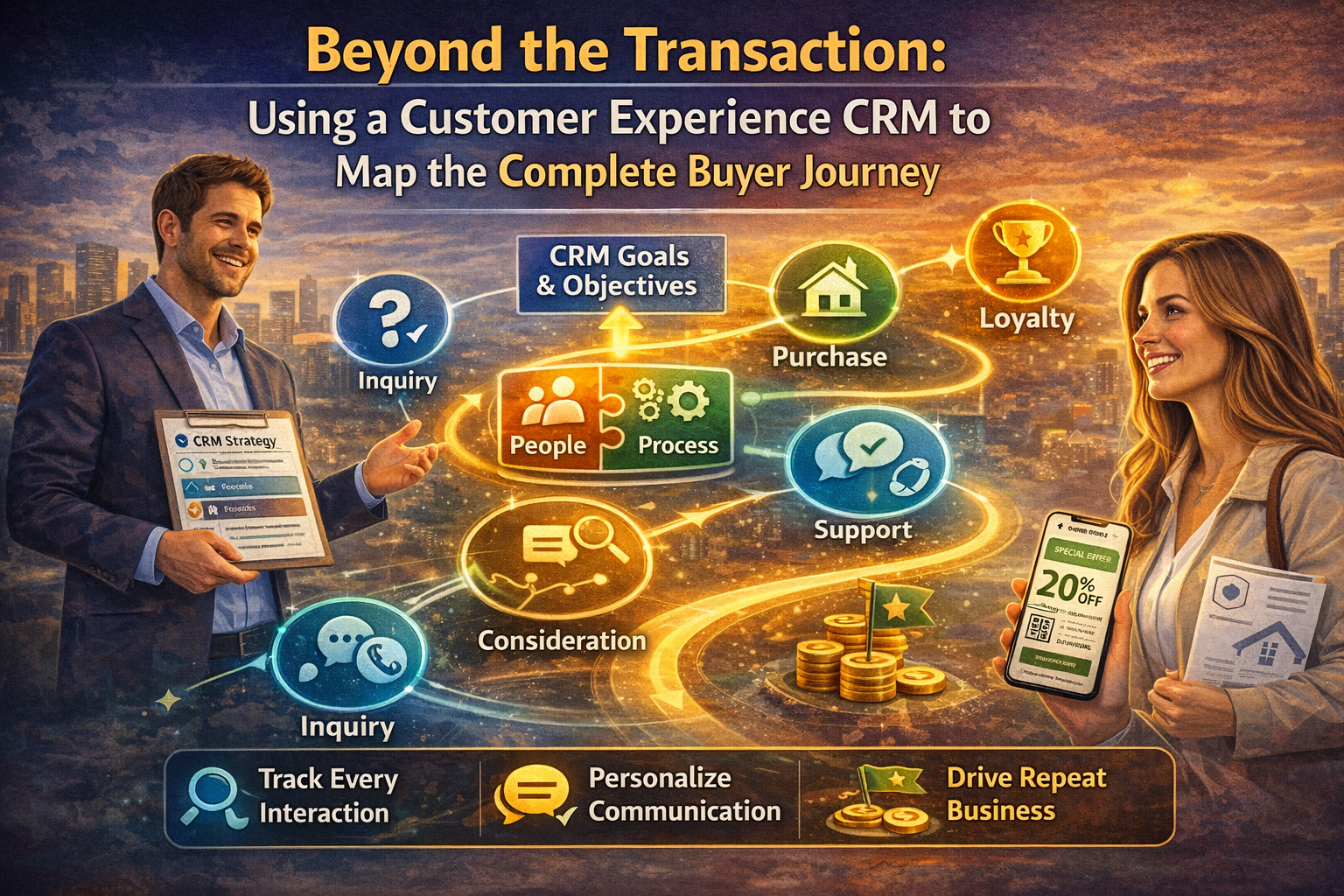
Master the art of journey mapping. Learn how a Customer Experience CRM helps you visualize every touchpoint, close the gaps in your funnel, and build lasting loyalty.
Table of Contents
We’ve all had that one frustrating interaction with a brand where it felt like the left hand had no idea what the right hand was doing. You talk to a sales rep on Monday, but when you call support on Tuesday, you have to explain your entire life story all over again. It’s exhausting. For a business, this kind of fragmented communication is a silent killer. It doesn’t matter how good your product is; if the process of buying it feels like navigating a maze in the dark, people will eventually stop trying.
This is where the shift from a traditional sales-only database to a robust Customer Experience CRM becomes the turning point for a scaling company. We’re moving away from the era where a CRM was just a digital rolodex for the sales team. Today, it has to be the nervous system of your entire organization. To truly win, you have to understand the journey from the customer’s eyes, and a Customer Experience CRM is the only tool that can provide that 360-degree view without making you lose your mind in the process.
The Myth of the Linear Sales Funnel
In the old days of marketing, we liked to pretend the buyer journey was a straight line. They saw an ad, they talked to a rep, they bought the thing, and everyone lived happily ever after. But if you’ve been in business for more than five minutes, you know that’s a fairy tale. Real life is messy. A customer might see a LinkedIn post, browse your site on their phone, sign up for a newsletter, ignore you for three months, and then suddenly call with an urgent request.
A standard CRM might track that final phone call, but a Customer Experience CRM captures all the “invisible” breadcrumbs left along the way. Mapping the buyer journey isn’t just about knowing when they bought; it’s about understanding why they moved forward and where they almost walked away. When you can see the friction points in real-time, you stop being reactive and start being proactive.
Why Experience is the New Competitive Advantage
I’ve noticed a significant change in how people shop over the last few years. Price and features still matter, obviously, but the “feeling” of the interaction has become the ultimate tie-breaker. If two companies offer the same service, the one that makes the process effortless wins every single time.
By leveraging a Customer Experience CRM, you are essentially investing in empathy at scale. You are making sure that every department—from marketing to billing—has the context they need to treat the customer like a human being, not just a ticket number. It’s about building a “single source of truth” so that the customer never has to repeat themselves. That level of consistency is rare, and in today’s market, it’s worth its weight in gold.
Visualizing the Touchpoints That Matter
If you’ve never sat down to actually draw out your buyer journey, you’re in for a surprise. Most businesses discover they have massive “blind spots” where customers are falling through the cracks. Using a Customer Experience CRM allows you to tag and track every interaction across different channels.
- The Discovery Phase: What was the first thing they ever saw? Was it a blog post or a referral?
- The Consideration Phase: Which case studies did they spend the most time on?
- The Decision Phase: What was the final question they asked before signing the contract?
- The Post-Purchase Phase: How was their onboarding experience?
When these phases are visualized in your Customer Experience CRM, you can start to see patterns. Maybe you realize that people who watch your demo video are 40% more likely to close. Great—now you know to push that video earlier in the journey.
Closing the Gap Between Marketing and Sales
The “hand-off” is usually where the journey breaks. Marketing generates a lead, tosses it over the fence, and Sales complains that the lead is cold. It’s a tale as old as time. A Customer Experience CRM acts as the bridge between these two islands.
Instead of just getting a name and an email, the sales rep can see that the lead has visited the pricing page three times in the last 48 hours. That context changes the entire opening of the sales call. It moves the conversation from “Are you interested in our services?” to “I saw you were looking at our premium tier—do you have questions about the integration features?” This level of personalized marketing is only possible when your tech stack is unified.
Improving Retention with Proactive Support
Most people think the buyer journey ends at the “Thank You” page. In reality, that’s just the beginning of the most important part: the relationship. A Customer Experience CRM shines in the post-purchase phase by tracking usage and sentiment.
If a customer hasn’t logged into their portal in two weeks, your Customer Experience CRM should trigger an alert. Instead of waiting for them to cancel, your success team can reach out with a helpful “How can we help?” message. This is how you move from a high-churn model to a customer lifetime value model. It’s much cheaper to keep an existing customer happy than it is to find a new one.
The Role of Sentiment and Feedback
Data isn’t just about clicks and opens; it’s about how people feel. Many modern systems now allow you to integrate Net Promoter Scores (NPS) and CSAT surveys directly into the contact record.
When you look at a profile in your Customer Experience CRM, you shouldn’t just see their billing history. You should see if they’re a “promoter” or a “detractor.” This allows your team to prioritize high-value advocates for referrals while immediately addressing the concerns of someone who had a bad experience. For more on the psychological impact of these interactions, the Wikipedia page on Customer Experience offers some great background on the transition from transactional to relational business.
Leveraging Data for Seamless Personalization
We’ve all received those “personalized” emails that just put our first name in the subject line. That’s not personalization; that’s a mail merge. True personalization is about sending the right content at the right time because you actually know what the person needs.
A Customer Experience CRM allows you to segment your audience based on their actual behavior during the journey. If a customer is clearly in the “research” phase, don’t hit them with a “Buy Now” coupon. Send them a whitepaper. If they’ve been with you for a year, send them an “Insider” update. This workflow automation ensures that your brand feels thoughtful rather than thirsty.
Protecting the Integrity of the Journey
As your business grows, the journey naturally becomes more complex. You add more products, more team members, and more communication channels. Without a Customer Experience CRM, this complexity usually leads to chaos.
A centralized system keeps everyone on the same page. It ensures that the “brand voice” remains consistent whether the customer is talking to a chatbot, an account manager, or a billing clerk. According to the research at Gartner, companies that prioritize the end-to-end experience see a much higher ROI on their marketing spend. It’s about building a foundation that can support growth without sacrificing the personal touch.
Strategic Mapping: How to Start
You don’t have to map every tiny detail on day one. Start with the “big” moments. Identify the four or five key events that a customer must experience to move from a stranger to a fan.
Once you have those, build your Customer Experience CRM fields to capture those events. Make it easy for your team to log notes and for your system to pull in automated data. The goal is to create a living, breathing document of the customer’s life with your company. Over time, you’ll refine this map until the journey feels like a paved road rather than an obstacle course.
FAQ Section
1. How is a Customer Experience CRM different from a Sales CRM? A sales CRM focuses on the “pipeline”—deals, quotas, and closing. A Customer Experience CRM focuses on the “lifecycle”—from the first ad click to long-term loyalty and advocacy. It’s a broader tool that involves marketing, sales, and customer success.
2. Do I need a huge team to map the buyer journey? Not at all. Even a small business can map the basic steps. The important part is having a Customer Experience CRM that can automate the data collection so you aren’t spending all your time on manual entry.
3. Can I still use my current tools? Usually, yes. Most Customer Experience CRM platforms are designed to integrate with your existing email, social media, and support tools. The goal is to bring all that data into one place so you have a “unified profile” for every customer.
4. How does journey mapping help with ROI? By identifying where people drop off in the funnel, you can fix specific problems rather than just spending more on ads. Improving your conversion rate by even 5% through a better experience is often more profitable than doubling your lead volume.
5. What is “Customer Sentiment” tracking? It’s the process of using surveys and interaction history to gauge if a customer is happy or frustrated. A Customer Experience CRM helps you track this over time so you can predict who might churn and who might be ready for an upgrade.
6. Is journey mapping a one-time project? No. Markets change and customer expectations evolve. You should review your buyer journey inside your Customer Experience CRM at least once a quarter to ensure your “map” still reflects the reality of how people are buying today.
Conclusion
At the end of the day, your customers don’t see your departments; they just see your brand. They don’t care that Sales didn’t talk to Support—they just care that their problem wasn’t solved. Moving to a Customer Experience CRM is a commitment to seeing things from their perspective.
