
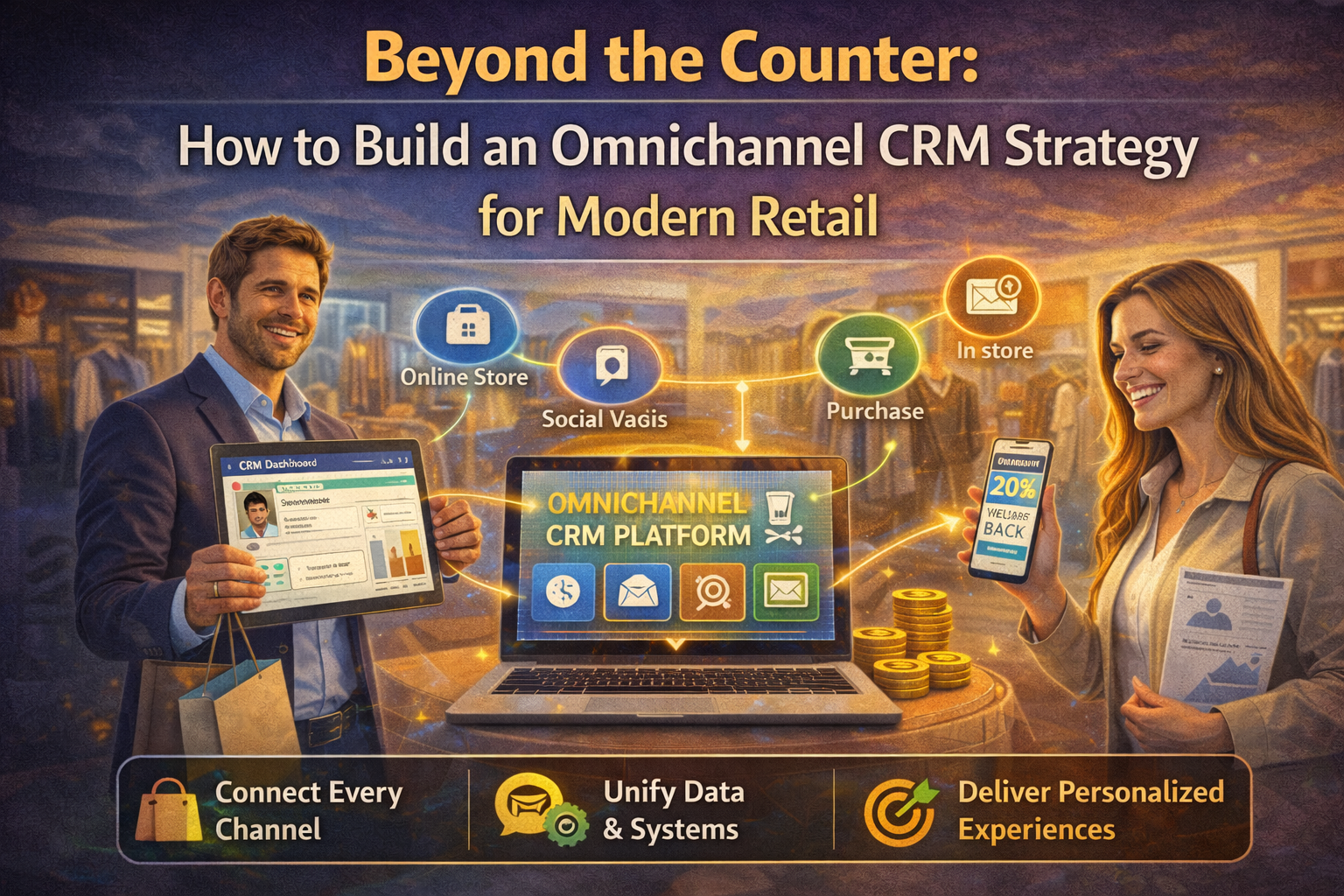
Stop frustrating your customers with disconnected support. Learn how to build an Omnichannel CRM Strategy that unifies your store, web, and social channels.
Table of Contents
We’ve all been there as shoppers. You buy a pair of shoes online, they don’t fit, so you walk into the physical store to exchange them. You expect the person behind the counter to know exactly who you are. Instead, they ask for a printed receipt, a 16-digit order number, and your blood type just to find the transaction. It feels like you’re dealing with two completely different companies. For a customer, this is the ultimate friction point. For a retailer, it’s a sign that your backend systems are living in 1998.
In a world where we jump from Instagram ads to mobile apps to physical storefronts in the span of a lunch break, the concept of “channels” shouldn’t exist for the user. They just see your brand. This is why every modern retailer eventually hits a wall where they realize they need a comprehensive Omnichannel CRM Strategy. It isn’t just a fancy technical upgrade; it’s a fundamental shift in how you recognize and serve the people who keep your lights on. When you unify your data, you stop being a transactional vendor and start being a cohesive service provider.
The Problem with Multichannel Silos
Most businesses think they are being modern because they have a website, a Facebook page, and a physical shop. But if those three things don’t talk to each other, you aren’t omnichannel—you’re just “multichannel.” Multichannel is often a mess of silos where data goes to die. If a customer complains on Twitter, but your phone support agent has no record of it, you’ve failed the experience test.
A successful Omnichannel CRM Strategy acts as the connective tissue between these islands of information. It ensures that regardless of where a conversation starts, it can continue seamlessly elsewhere. You want your support staff to have a 360-degree view of the customer the second a ticket is opened. When you remove the need for customers to repeat themselves, you immediately boost your brand’s perceived value.
Why Personalization is the New Standard
I’ve noticed a major shift in consumer expectations lately. We’ve been spoiled by the “Amazon effect.” We now expect every retailer to remember our preferences, our sizes, and our past headaches. If you don’t have a solid Omnichannel CRM Strategy in place, providing this level of personalized service is basically impossible at scale.
When your CRM is properly integrated, a floor manager can see that a customer just browsed a specific jacket online but didn’t buy it. They can then offer that person a tailored experience the moment they walk through the door. This isn’t just “good salesmanship”—it’s the result of having a data-driven infrastructure that prioritizes the customer journey over individual sales targets.
Building the Technical Foundation
Setting up an Omnichannel CRM Strategy isn’t something you do over a weekend. It requires a hard look at your current “tech stack.” You need to ensure that your Point of Sale (POS), your e-commerce platform, and your social media management tools are all feeding into one central brain.
- Data Centralization: Move away from individual databases for web and in-store. Use a unified profile system.
- Real-Time Sync: If someone buys the last item in-store, your website should reflect that stock level immediately to prevent overselling.
- Identity Resolution: Use emails and phone numbers to “stitch” together anonymous web visits with known in-store purchases.
A well-executed Omnichannel CRM Strategy relies on this “single source of truth.” If your data is laggy or fragmented, your support team will constantly be apologizing for being out of the loop.
Streamlining the Support Experience
Let’s talk about the “Support” part of the equation. Traditionally, retail support was a reactive game. Someone calls with a problem, and you fix it. But with a robust Omnichannel CRM Strategy, support becomes a continuous thread.
If a customer starts a chat on your website about a defective product and then later calls your help desk, the agent should see the entire chat transcript immediately. This level of workflow automation reduces “average handle time” and increases customer satisfaction scores (CSAT). You’re moving from “What can I help you with?” to “I see you were chatting about that defective blender—did the troubleshooting steps work?” That difference is massive in building long-term customer loyalty.
Leveraging Social Media as a Support Channel
Social media is no longer just for posting pretty pictures; it’s a frontline support hub. Most customers would rather send a Direct Message (DM) than sit on hold for twenty minutes. However, if your social team is disconnected from your CRM, they can’t actually solve any problems.
By including social platforms in your Omnichannel CRM Strategy, you empower your community managers to see a customer’s full purchase history. They can issue refunds, track shipping, or offer discounts directly through the social interface. This turns a public complaint into a private, professional resolution. For more on how digital channels have evolved, the Wikipedia page on Omnichannel offers some great historical context on the move from traditional retail to integrated commerce.
Improving Inventory Visibility
There is nothing more frustrating for a customer than seeing an item “In Stock” online, driving to the store, and finding an empty shelf. An Omnichannel CRM Strategy actually helps bridge this gap by linking customer demand with supply chain data.
When you know what your customers are looking for across all channels, you can make better decisions about resource allocation. You can ship items from a store that has high stock to a customer who ordered online in a different city. This “ship-from-store” model is only possible when your CRM and inventory systems are talking in real-time. It maximizes your profit margins and keeps your customers happy.
The Role of Mobile in the Omnichannel Strategy
The smartphone is the ultimate bridge between the physical and digital worlds. A central part of your Omnichannel CRM Strategy should involve a mobile app or a mobile-optimized web experience. This allows you to use things like “geofencing” to send a welcoming push notification when a loyal customer is near your store.
However, you have to be careful not to cross the line from “helpful” to “creepy.” The goal of a Omnichannel CRM Strategy is to add value, not to act as a stalker. Use the data to offer a “Buy Online, Pick Up In Store” (BOPIS) option or to provide an easy way for customers to see their past receipts for quick returns. According to the research at Gartner, retailers who provide a seamless mobile-to-store transition see a much higher customer lifetime value.
Training Your Staff for the Change
You can buy the best software in the world, but if your staff doesn’t know how to use it, your Omnichannel CRM Strategy will fail. The human element is where the rubber meets the road. Your employees need to understand that the CRM is a tool to help them provide better service, not just a way for management to track their numbers.
Hold training sessions that focus on the customer experience. Show them how to look up a customer’s online wishlist to help them find things in-store. Encourage them to log notes about a customer’s preferences (e.g., “Prefers organic fabrics”). This data is the “secret sauce” that makes your Omnichannel CRM Strategy feel human rather than mechanical.
Data Privacy and the Trust Factor
With more data comes more responsibility. As you build out your Omnichannel CRM Strategy, you must prioritize data security. Customers are willing to share their information if they get a better experience in return, but that trust is fragile.
Ensure you are compliant with local regulations like GDPR or CCPA. Be transparent about what data you are collecting and why. A “Privacy First” approach should be baked into your Omnichannel CRM Strategy from day one. If a customer asks you to delete their data, you should be able to wipe it from every channel—not just your email list.
Measuring the Success of Your Strategy
How do you know if your Omnichannel CRM Strategy is actually working? You have to look past simple sales numbers.
- Cross-Channel Purchase Rate: Are people who follow you on social media buying in-store?
- Support Ticket Resolution Time: Is the unified data helping agents close cases faster?
- Repeat Purchase Rate: Are people coming back more often because the experience is easy?
By tracking these CRM reporting metrics, you can see where the friction still exists and refine your approach. A strategy isn’t a “set it and forget it” project; it’s an ongoing evolution.
FAQ Section
1. Is an Omnichannel CRM Strategy too expensive for small retailers? Not necessarily. Many modern, cloud-based CRMs offer affordable tiers for small businesses. The key is to start small by integrating your website and your physical POS first, then adding other channels like social media as you grow.
2. How long does it take to see results? You will likely see an improvement in support efficiency within the first 3 to 6 months. Improvements in customer retention and cross-channel sales usually take a bit longer as you collect more data and refine your personalized offers.
3. What is the biggest mistake retailers make? Failing to train their staff. You can have a perfect Omnichannel CRM Strategy on paper, but if your store employees don’t know how to look up an online order, the customer experience will still feel broken.
4. Do I need to build my own CRM? Almost never. There are plenty of high-quality platforms on the market that are specifically built for retail. It is much better to find a tool that has existing integrations for your e-commerce and POS systems than to try and build something from scratch.
5. How does this strategy help with “Showrooming”? Showrooming is when people look at items in-store but buy them online from a competitor. A strong Omnichannel CRM Strategy helps you fight this by allowing you to offer an immediate, personalized discount or “price match” while the customer is still in your store.
Conclusion
At the end of the day, retail is still about relationships. The only difference is that those relationships now happen across six different screens and two different physical locations. Setting up a Omnichannel CRM Strategy is your way of saying to your customers, “I see you, I value your time, and I’m making this as easy as possible for you.”
