
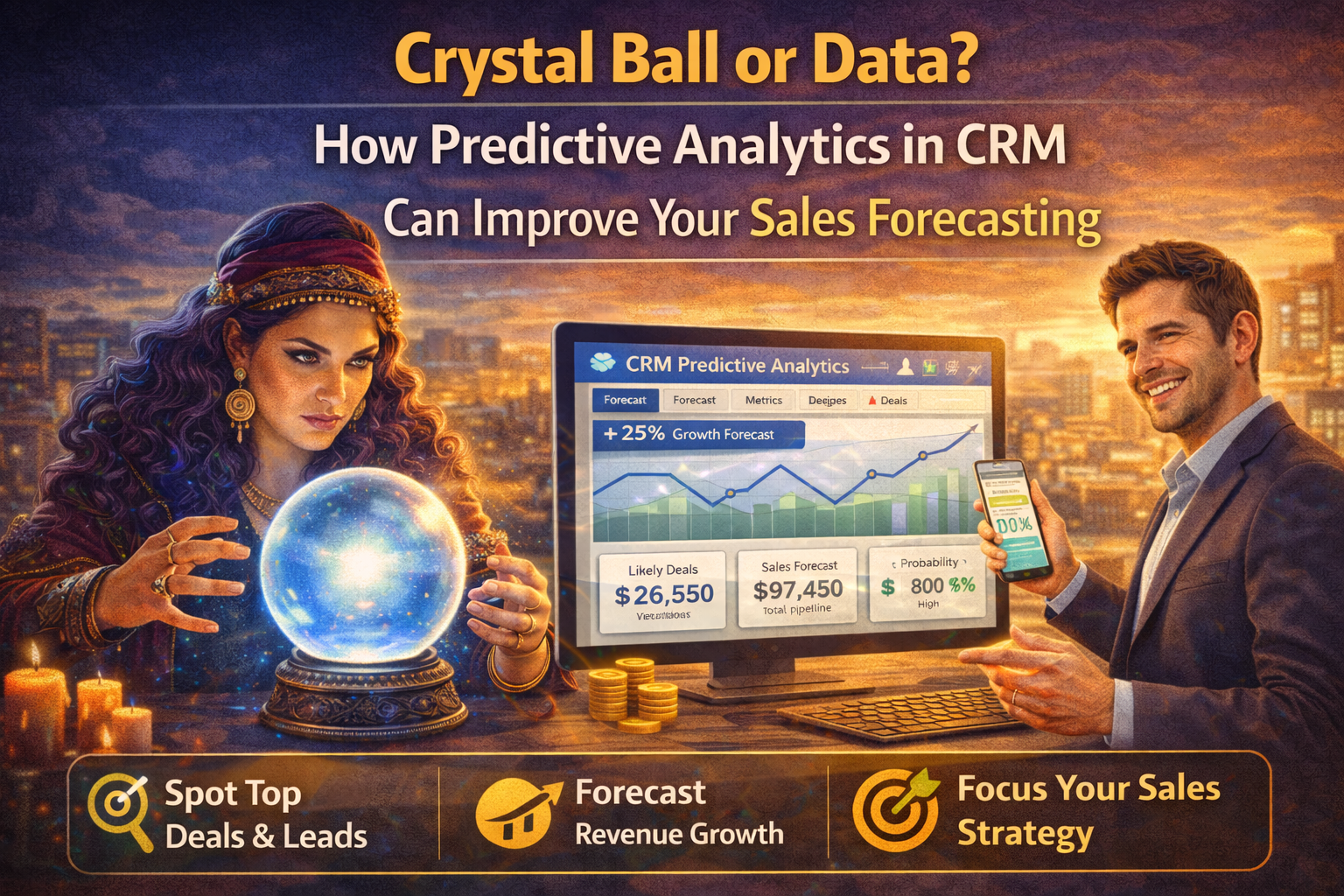
Stop guessing your revenue. Discover how Predictive Analytics in CRM uses historical data and machine learning to create pinpoint accurate sales forecasts.
Table of Contents
I’ve sat through enough end-of-quarter “war room” meetings to know the feeling of pure, unadulterated stress. You’re looking at a spreadsheet full of deals that your sales reps swear are “90% likely to close,” but deep down, you know that half of them are stuck in administrative limbo. You’ve promised the board a certain number, and now you’re sweating bullets because your forecast is based more on optimism than actual reality. It’s the classic sales leader’s dilemma: relying on a gut feeling in a world that demands hard data.
This is exactly where the shift toward Predictive Analytics in CRM changes everything. We are moving away from the era of “guess-timating” and into a time where your database can actually tell you what’s likely to happen next. It isn’t magic, and it isn’t about replacing the human element of sales; it’s about giving your team a flashlight in a dark room. When you leverage Predictive Analytics in CRM, you stop reacting to the market and start anticipating it.
The Problem with Traditional Forecasting
Most sales forecasts are built on “weighted pipelines.” You take the total value of the deals in a certain stage and multiply it by a fixed percentage. It’s simple, but it’s incredibly flawed. It doesn’t account for the fact that a deal might have been sitting in the “Negotiation” phase for six months, or that a specific rep always overestimates their closing probability.
Traditional methods look backward at what happened, but they don’t look deep into the patterns of what happened. Predictive Analytics in CRM fills this gap by analyzing thousands of data points—from email response times to historical seasonal trends—to give you a much more honest picture of your future revenue. It identifies the “hidden” signals that a human might miss in the daily grind of closing deals.
What Exactly is Predictive Analytics in the Context of Sales?
At its core, Predictive Analytics in CRM is about using historical data to make statistical “best guesses” about future outcomes. It uses machine learning algorithms to scan your entire CRM history and find correlations. For instance, it might notice that whenever a prospect skips a scheduled demo, the likelihood of that deal closing drops by 40%, regardless of what the sales rep says in their notes.
It’s about turning your CRM from a digital filing cabinet into an active advisor. By implementing Predictive Analytics in CRM, you are essentially hiring a data scientist that works 24/7 to find the flaws in your pipeline. This level of insight allows you to focus your resources on the deals that actually have a chance of crossing the finish line.
Improving Accuracy with Lead Scoring
One of the most immediate benefits of Predictive Analytics in CRM is the evolution of lead scoring. Most companies use “rules-based” scoring (e.g., +5 points for a website visit). But predictive models go deeper. They look at “look-alike” data.
The system analyzes your most successful past customers and then ranks your current leads based on how closely they match that “Ideal Customer Profile” (ICP). When you use Predictive Analytics in CRM for lead scoring, your sales team stops wasting time on “tire kickers” and starts focusing on high-intent prospects. This directly improves your sales velocity because the path from initial contact to closed-won is much clearer.
Identifying At-Risk Deals Before They Die
There is nothing worse than a deal that goes “dark” right when you expect it to close. Usually, there were warning signs—shorter emails, longer gaps between calls, or a change in the primary contact person. Humans are great at ignoring these signs because we want the deal to happen.
Predictive Analytics in CRM doesn’t have emotions. It tracks engagement metrics with brutal honesty. If the model sees that a “High Priority” deal is showing the same behavioral patterns as past deals that were eventually lost, it flags it. This allows sales managers to step in early with a save strategy, whether that’s a discount, a new case study, or a call from an executive.
Optimizing Resource Allocation
In a scaling business, your most valuable resource is time. If your managers are spending all their time coaching reps on deals that have a 5% chance of closing, your customer acquisition cost (CAC) is going to skyrocket.
Using Predictive Analytics in CRM helps you decide where to double down. If the data shows that your mid-market segment is closing 20% faster than your enterprise segment this quarter, you can shift your marketing spend and your SDR focus to capture that momentum. It’s about being agile in a way that traditional, static forecasting simply doesn’t allow. For more on how data structures impact these decisions, you can check the Wikipedia page on Predictive Analytics.
The Role of Historical Data Quality
I have to be honest: Predictive Analytics in CRM is only as good as the data you’ve been feeding it for the last two years. If your CRM is a mess of duplicates and incomplete records, the model is going to produce garbage results.
Data hygiene is the “boring” work that makes the “cool” tech work. Before you can truly benefit from Predictive Analytics in CRM, you need to ensure your team is consistently logging their interactions. The more “texture” the data has—dates, titles, specific touchpoints—the more accurate the machine learning model becomes. It’s a classic case of “garbage in, garbage out.”
Enhancing Customer Lifetime Value (CLV)
Forecasting isn’t just about new business; it’s about knowing which current customers are likely to grow and which ones are likely to churn. Predictive Analytics in CRM can analyze usage patterns and support tickets to identify “churn signals.”
If a long-term client suddenly stops using a specific feature of your software, the system can alert your customer success management team. Conversely, it can identify “expansion” opportunities by noticing when a customer is hitting the limits of their current plan. This proactive approach to retention marketing is much more effective than waiting for a cancellation email to arrive.
Aligning Sales and Marketing
One of the oldest wars in business is between Sales and Marketing. Marketing thinks the leads are great; Sales thinks they’re terrible. Predictive Analytics in CRM acts as the objective referee.
When both teams agree on a predictive model that defines what a “qualified” lead looks like based on historical closing data, the friction disappears. Marketing can optimize their campaigns for high-scoring leads, and Sales can trust that the leads in their queue are actually worth calling. This alignment is a massive driver of conversion rate improvements across the board. According to research from Gartner, companies that lead with data-driven sales strategies see significantly higher profit margins.
The Human Element: Training Your Team to Trust the Data
The biggest hurdle isn’t the technology; it’s the culture. Salespeople are notoriously protective of their “gut feelings.” When you first introduce Predictive Analytics in CRM, you might face some pushback.
You have to show them, not just tell them. Show them a deal the system flagged as “low probability” that actually ended up being lost. Show them how much more money they make when they spend their time on high-scoring leads. When they see that Predictive Analytics in CRM is a tool to make them more successful—not a robot to replace them—the adoption happens naturally.
Measuring Success and Iterating
A predictive model isn’t a “set it and forget it” tool. Markets change, products evolve, and competitors launch new features. You need to constantly review the accuracy of your Predictive Analytics in CRM output.
- Forecast Variance: How close was the predicted revenue to the actual revenue?
- Win Rate Accuracy: Did the “High Probability” deals actually win at the expected rate?
- Lead Conversion: Has the quality of the pipeline improved since implementing the model?
By tracking these CRM reporting metrics, you can fine-tune the algorithm. It’s a process of continuous improvement that makes your business more resilient over time.
FAQ Section
1. Is Predictive Analytics in CRM only for large enterprises? No. While large companies have more data to feed the model, many modern CRMs now offer “out-of-the-box” predictive features for mid-sized businesses. As long as you have a consistent sales process and at least a year of historical data, you can start seeing the benefits of Predictive Analytics in CRM.
2. Does this replace the need for sales managers to review deals? Absolutely not. The technology provides the “what,” but the manager provides the “why.” A model might tell you a deal is at risk, but a manager can figure out if it’s because of a pricing issue or a personality clash between the rep and the buyer.
3. How long does it take to set up? If your CRM data is already clean, you can often turn on predictive features in a few days. However, it usually takes 3 to 6 months of “learning” for the model to truly understand the nuances of your specific sales cycle and provide highly accurate sales forecasting.
4. Can predictive analytics help with cold outreach? Yes. By analyzing which types of companies have converted in the past, Predictive Analytics in CRM can help you build “ideal” prospecting lists. This ensures your outbound efforts are targeted at the people most likely to actually need your solution.
5. What is the biggest risk of using predictive models? The biggest risk is “complacency.” If your team stops thinking critically because “the computer said it would close,” you are in trouble. Predictive Analytics in CRM is an advisory tool, not a decision-maker.
Conclusion
At the end of the day, sales is still about people. It’s about trust, solve-state selling, and building relationships. But in a world where data is everywhere, ignoring the insights offered by Predictive Analytics in CRM is like trying to sail a ship without a compass. You might eventually get to your destination, but you’re going to hit a lot of avoidable rocks along the way.
