
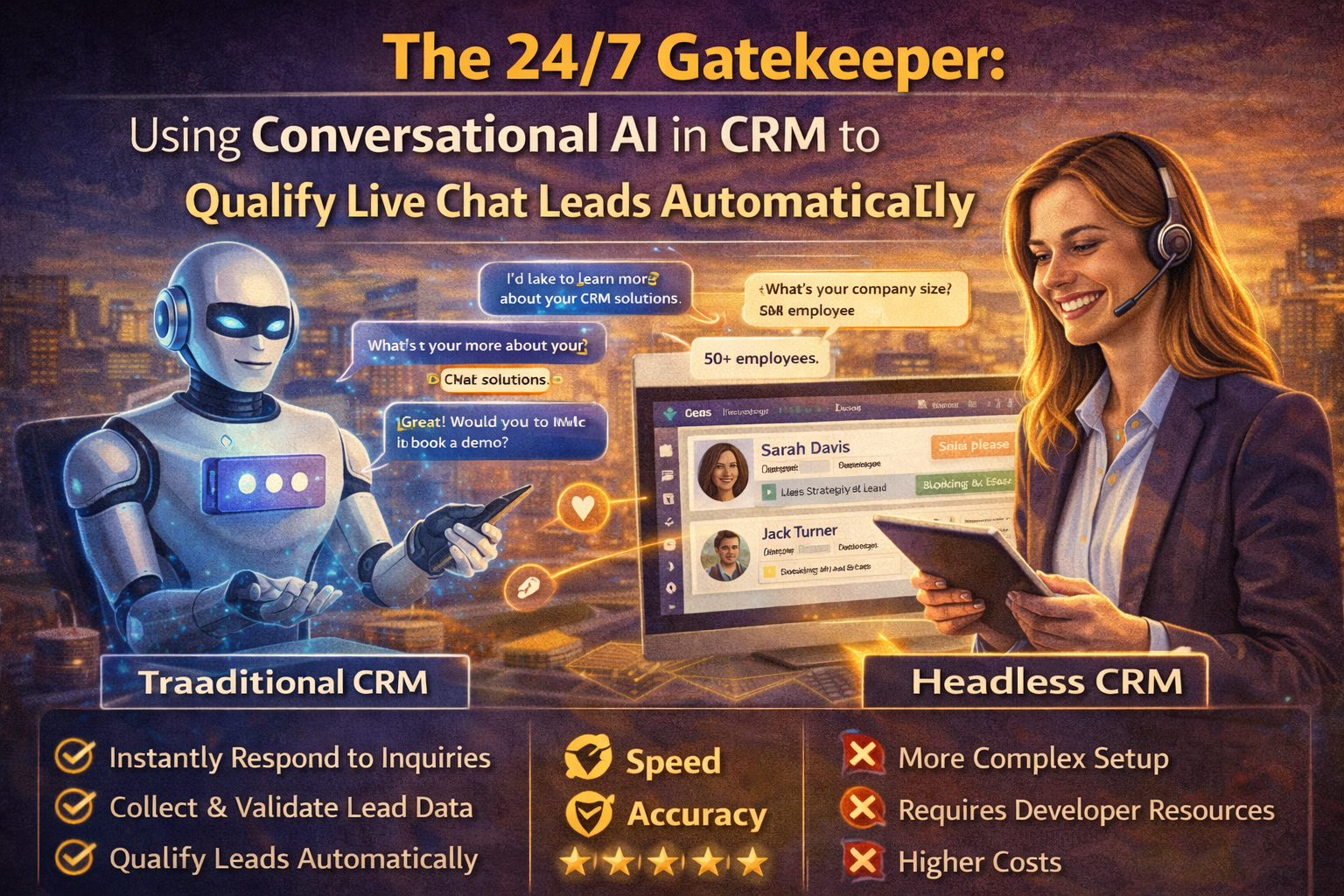
Scale your sales without the burnout. Learn how Conversational AI in CRM automates lead qualification in live chat to deliver sales-ready prospects instantly.
Table of Contents
We’ve all been there: it’s 9:00 PM on a Tuesday, you’re finally settling in for the night, and a notification pings on your phone. A potential customer is on your website, asking questions in the live chat. Part of you wants to jump on it because you know speed-to-lead is everything, but the other part of you just wants to finish your dinner. If you ignore them, they’ll probably wander off to a competitor. If you answer, you might spend forty minutes talking to someone who doesn’t even have the budget for your services.
This is the classic “scaling wall” that every growing business eventually hits. You need to be responsive, but your time is too valuable to spend it on “tire-kickers” who are just browsing. This is precisely why the integration of Conversational AI in CRM has become the secret weapon for modern sales teams. It isn’t just about having a chatbot that says “hello”; it’s about having an intelligent system that can actually think, qualify, and route leads while you’re sleeping, eating, or closing a different deal.
Moving Beyond the “If/Then” Chatbot
For a long time, live chat was a bit of a letdown. You either had to staff it with expensive human agents or use those rigid, “button-based” bots that felt like talking to a digital brick wall. If the user asked a question that wasn’t in the pre-defined script, the whole thing fell apart.
The new era of Conversational AI in CRM is fundamentally different. These systems use natural language processing to understand intent. They can handle “messy” human conversation, interpret nuances, and follow a logical path to extract the information your sales team actually needs. Instead of just collecting an email address, the system conducts a mini-discovery call. It feels like a conversation, but it functions like a filter.
The Art of the Automated Qualification
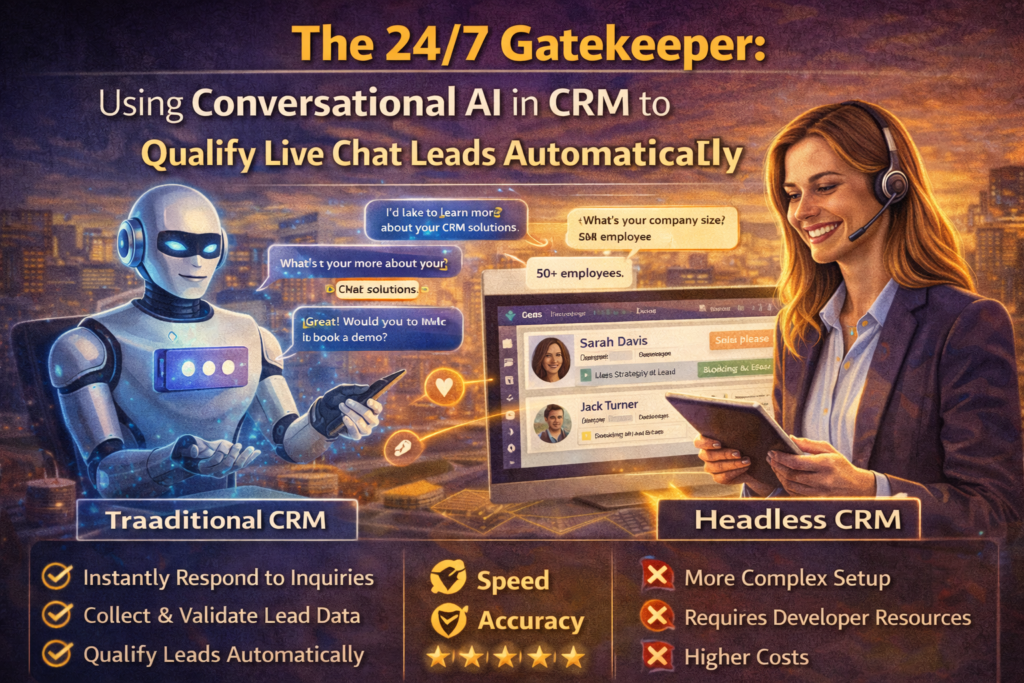
The primary goal of using Conversational AI in CRM isn’t to replace your sales reps; it’s to make them more effective. Think of the AI as a high-level executive assistant. It sits on your website, greets every visitor, and starts asking the qualifying questions that you’ve pre-defined.
- Budget Verification: “Are you looking to invest in a solution within the $5,000 to $10,000 range?”
- Authority Check: “Will you be the primary decision-maker for this project, or are you gathering info for your team?”
- Need Identification: “What is the biggest challenge you’re currently facing with your property management?”
- Timeline Mapping: “Are you looking to implement a new system in the next 30 days, or are you just starting your research?”
By the time the lead actually reaches a human, the Conversational AI in CRM has already tagged them with a lead score and attached a transcript of the conversation to their contact record. This means your reps don’t start the call with “So, tell me about your business.” They start with “I saw you’re looking for a solution for your 200-unit portfolio by next month—let’s talk about how we can help.”
Closing the Gap Between Marketing and Sales
I’ve spent a lot of time talking to marketing directors who are frustrated that their “great leads” are being ignored by the sales team. Usually, the sales team ignores them because they’ve been burned by low-quality data in the past.
Conversational AI in CRM acts as the peacekeeper. Because the AI is directly connected to your database, it can cross-reference visitors in real-time. If a “VIP” client from your existing real estate portfolio lands on the site, the AI can recognize them and provide a different experience than it would for a brand-new stranger. This level of personalized marketing ensures that high-value opportunities are fast-tracked while lower-priority inquiries are nurtured through automated email sequences.
24/7 Responsiveness Without the Headcount
Let’s be honest: hiring a 24/7 global support and sales team is incredibly expensive. Most mid-sized firms simply can’t justify the overhead. But in a global market, your customers might be waking up in London just as you’re going to bed in Surat.
By leveraging Conversational AI in CRM, you provide an “always-on” storefront. The AI doesn’t get tired, it doesn’t take lunch breaks, and it doesn’t get frustrated by repetitive questions. It maintains a consistent “brand voice” across every single interaction. According to the architecture standards found at the Open Group, the move toward these autonomous service layers is a key part of digital transformation for enterprises.
Mapping the Journey in Real-Time
A major benefit of this technology is the “breadcrumbing” effect. Traditional forms give you a snapshot, but Conversational AI in CRM gives you a movie. You can see the exact path a user took—the questions they asked, the hesitations they had, and the specific features they were curious about.
This data is invaluable for refining your customer journey. If you notice that 40% of people drop off when the AI asks about their budget, maybe your pricing is too opaque or your qualification happens too early. This real-time feedback loop allows you to optimize your sales funnel on the fly, rather than waiting for a monthly report to tell you something is broken.
Improving Accuracy with Lead Scoring
When you integrate Conversational AI in CRM, your lead scoring moves from “best guess” to “data-driven.” The AI can assign points based on the sentiment of the chat.
If a user is using urgent language (e.g., “need this immediately,” “current system crashed”), the AI can instantly trigger an “Emergency Lead” notification to your top closer. Conversely, if someone is just asking for a “free PDF,” the Conversational AI in CRM can politely guide them to a self-service resource and tag them for a long-term retention marketing campaign. For more on the technical side of how these systems interpret human speech, Wikipedia’s page on Natural Language Processing is a great deep dive.
The Human Element: When to Hand Off
The secret to success with Conversational AI in CRM is knowing when the robot should step aside. There is a “uncanny valley” where if a bot tries too hard to be human, it becomes annoying.
The best setups are transparent. “Hi, I’m the digital assistant for [Your Company]. I can help you get started, and if things get complex, I’ll bring in one of our experts.” This sets clear expectations. Once the AI has gathered the “BANT” (Budget, Authority, Need, Timeline) data, it should offer a “Live Hand-off” if a rep is available, or a “Meeting Scheduler” link if they aren’t. This seamless transition is what creates a high-end user experience.
Data Hygiene and the Single Source of Truth
One of the biggest headaches for any manager is “dirty data.” Reps forget to log notes, or they enter info in the wrong fields. Conversational AI in CRM solves this by doing the data entry automatically.
Every detail gleaned from the chat—company size, current pain points, even their preferred contact time—is pushed directly into the relevant fields in your CRM. This ensures your CRM Data Governance is airtight. When your sales team opens a lead record, they see a clean, structured history. No more hunting through old email threads or trying to remember what was said on a Friday afternoon call.
The ROI of Automated Qualification
When you sit down to justify the cost of implementing Conversational AI in CRM, look past the “cool factor” and focus on the math.
- Reduction in CAC: You’re spending less time on leads that will never close.
- Increase in Sales Velocity: Deals move faster when the first “discovery” is already done.
- Higher Employee Satisfaction: Your reps get to do what they love—closing deals—instead of chasing dead-end leads.
According to research from Gartner, companies that embrace AI-driven engagement see a significant boost in their profit margins. It’s not about cutting costs; it’s about amplifying your existing team’s power.
FAQ Section
1. Does Conversational AI in CRM replace my human live chat agents? Not necessarily. It’s better to think of it as a “front-line” filter. The AI handles the initial greeting, basic questions, and qualification. This frees up your human agents to handle the complex, high-emotion conversations where a personal touch is actually required.
2. Can I use this for my real estate brokerage? Absolutely. In fact, it’s a perfect fit. The AI can ask about preferred neighborhoods, budget ranges, and whether the lead has a “pre-approval” letter, all while you’re out showing houses. It ensures your listing agreement opportunities are never missed.
3. Is it hard to set up the qualification logic? Most modern platforms use a “drag-and-drop” interface. You don’t need to be a coder. You just need to know your sales process. If you can write out a list of the top five things you need to know before a call, you can set up a Conversational AI in CRM flow.
4. How does the AI know when a lead is “qualified”? You set the rules. You can tell the system that a lead is “hot” if they have a budget over $X and a timeline of less than 3 months. The AI then uses these parameters to trigger notifications or schedule appointments.
5. Does this work on mobile devices? Yes, and it’s actually where it’s most effective. Most visitors are on their phones, and they hate filling out long forms. A chat interface is much more natural and has a much higher conversion rate than a static “Contact Us” page.
6. What about data privacy and GDPR? A reputable Conversational AI in CRM setup will include built-in consent checks. The AI can ask the user to agree to your privacy policy before the conversation gets deep, ensuring you stay on the right side of GDPR compliance.
Conclusion
We are living in an era of “instant gratification.” If a visitor on your site has to wait four hours for a reply, they’ve already moved on. But you can’t be everywhere at once. Embracing Conversational AI in CRM is the only way to scale the human touch without losing your mind.
