
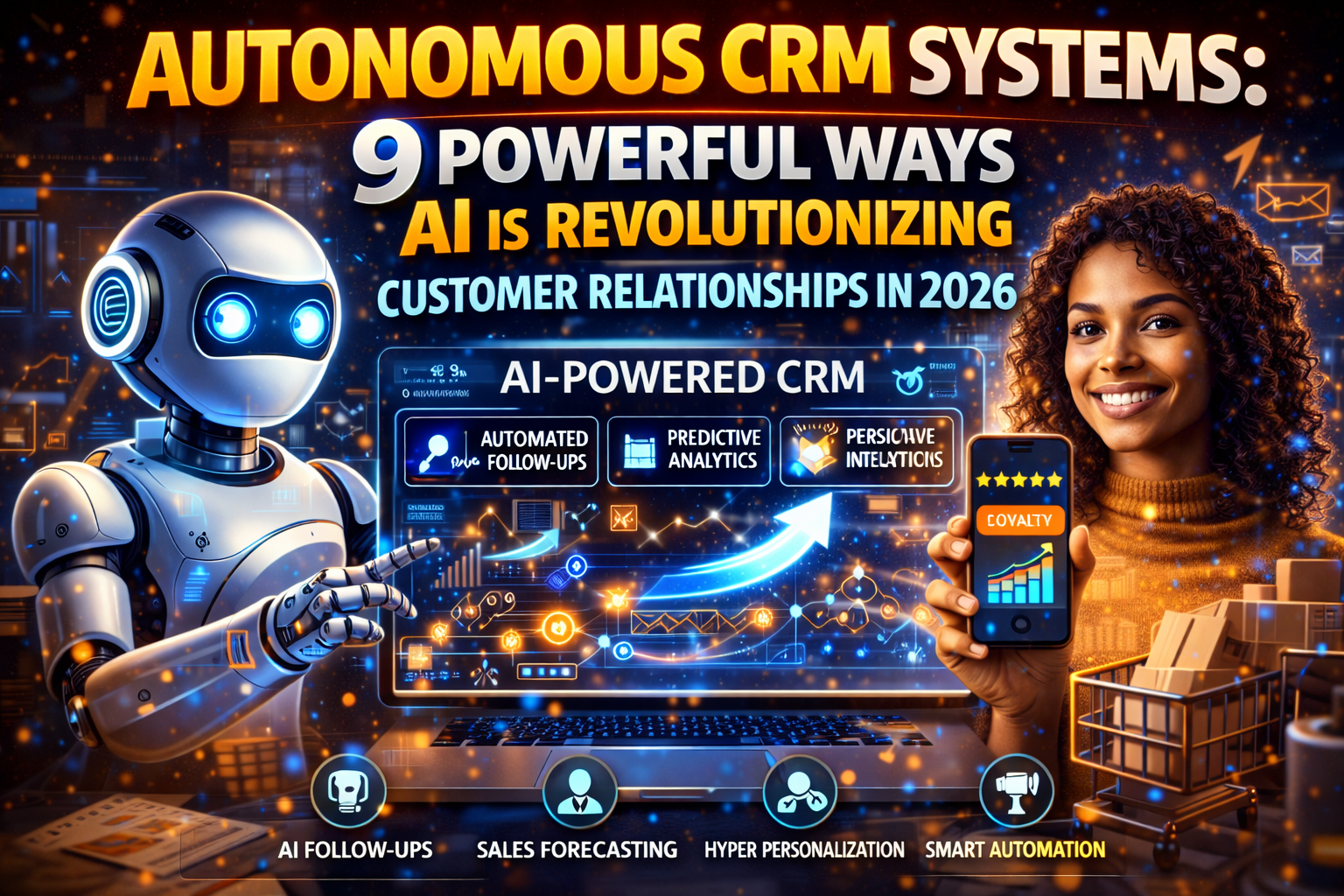
Discover how Autonomous CRM Systems are transforming businesses with AI-driven automation, predictive insights, and self-operating customer management strategies in 2026.
Table of Contents
Introduction
The world of Customer Relationship Management (CRM) is entering a new era—one where systems don’t just assist humans but operate independently. Welcome to the age of Autonomous CRM Systems.
In 2026, businesses are moving beyond traditional CRM platforms toward intelligent systems that can analyze data, make decisions, and execute actions without constant human input. These systems are powered by artificial intelligence (AI), machine learning (ML), and real-time analytics.
But what exactly are Autonomous CRM Systems, and why are they gaining so much attention globally?
In this blog, we’ll explore how these systems work, their benefits, challenges, and how they are reshaping the future of customer relationships.
What Are Autonomous CRM Systems?
Autonomous CRM Systems are advanced CRM platforms that use AI to automate decision-making and execution across customer interactions.
Unlike traditional CRM systems that require manual inputs and actions, autonomous systems can:
- Identify potential leads
- Analyze customer behavior
- Trigger marketing campaigns
- Recommend or take next-best actions
- Optimize customer journeys automatically
👉 Learn more about CRM fundamentals:
https://www.salesforce.com/crm/what-is-crm/
👉 Explore AI in CRM:
https://www.oracle.com/cx/what-is-crm/ai-in-crm/
Why Autonomous CRM Systems Are Rising in 2026
Several global trends are accelerating the adoption of Autonomous CRM Systems:
- Increasing customer expectations for personalization
- Explosion of data from multiple channels
- Need for faster decision-making
- Growth of AI and automation technologies
Businesses can no longer rely solely on manual processes—they need systems that can think and act in real time.
9 Key Ways Autonomous CRM Systems Are Transforming Businesses
1. Self-Operating Customer Journeys
Autonomous CRM systems can design and execute entire customer journeys without human intervention.
They:
- Track user behavior
- Segment audiences dynamically
- Trigger personalized campaigns
Result: Seamless and consistent customer experiences.
2. Predictive and Prescriptive Intelligence
These systems don’t just predict—they recommend and act.
For example:
- Identify high-value leads
- Suggest optimal pricing
- Automatically send targeted offers
👉 Learn about predictive analytics:
https://www.ibm.com/topics/predictive-analytics
3. Real-Time Decision Making
Autonomous CRM systems process data instantly.
This allows businesses to:
- Respond to customer actions immediately
- Deliver real-time offers
- Improve engagement
👉 Explore real-time analytics:
https://cloud.google.com/solutions/real-time-analytics
4. Hyper-Personalization at Scale
Personalization is no longer manual.
AI enables:
- One-to-one communication
- Dynamic content generation
- Personalized recommendations
👉 Learn about personalization strategies:
https://www.mckinsey.com/capabilities/growth-marketing-and-sales/our-insights
5. Intelligent Lead Management
Autonomous CRM systems automatically:
- Capture leads from multiple sources
- Score them based on behavior
- Assign or nurture them
This improves conversion rates significantly.
6. Automated Customer Support
AI-powered CRM integrates with chatbots and virtual assistants.
They can:
- Resolve common queries
- Provide instant responses
- Escalate complex issues
👉 Learn about AI customer service:
https://www.zendesk.com/blog/ai-customer-service/
7. Continuous Learning and Optimization
Machine learning enables CRM systems to improve over time.
They:
- Learn from past interactions
- Optimize campaigns
- Refine predictions
Result: Better performance with minimal human effort.
8. Omnichannel Integration
Autonomous CRM systems unify customer interactions across:
- Social media
- Websites
- Mobile apps
👉 Learn about omnichannel CRM:
https://www.oracle.com/cx/what-is-omnichannel/
This ensures a consistent customer experience.
9. Revenue Optimization
By automating and optimizing processes, these systems help:
- Increase conversions
- Reduce churn
- Maximize customer lifetime value
Technologies Behind Autonomous CRM Systems
1. Artificial Intelligence (AI)
Drives decision-making and automation.
2. Machine Learning (ML)
Improves predictions over time.
3. Big Data Analytics
Processes large volumes of customer data.
4. Natural Language Processing (NLP)
Enables communication through chat and voice.
5. Cloud Computing
Provides scalability and real-time access.
👉 Learn about cloud CRM:
https://aws.amazon.com/what-is/crm/
Benefits of Autonomous CRM Systems
1. Increased Efficiency
Automates repetitive tasks.
2. Better Customer Experience
Delivers personalized and timely interactions.
3. Higher Revenue
Improves conversion and retention rates.
4. Data-Driven Decisions
Eliminates guesswork.
5. Scalability
Handles growth without increasing workload.
Challenges and Risks
Despite their advantages, Autonomous CRM Systems come with challenges:
1. Data Privacy Concerns
Handling sensitive customer data requires compliance.
👉 Learn about data protection:
https://gdpr.eu/what-is-gdpr/
2. Over-Automation Risks
Too much automation can feel impersonal.
3. High Implementation Costs
Advanced systems may require significant investment.
4. Dependence on Data Quality
Poor data leads to inaccurate decisions.
Future of Autonomous CRM Systems
Looking ahead, Autonomous CRM Systems will evolve further with:
1. Fully Self-Driving Businesses
End-to-end automation of sales and marketing.
2. Emotion AI Integration
Understanding customer emotions for better engagement.
3. Web3 and Decentralized Data
Giving customers control over their data.
4. Voice-First CRM Interfaces
Managing CRM through voice commands.
How Businesses Can Prepare
To adopt Autonomous CRM Systems effectively:
- Invest in AI-powered CRM platforms
- Focus on clean and structured data
- Train teams on AI tools
- Balance automation with human touch
- Prioritize customer trust and transparency
Conclusion
The rise of Autonomous CRM Systems marks a significant shift in how businesses manage customer relationships.
These systems are not just tools—they are intelligent partners that:
- Predict customer behavior
- Make decisions
- Execute strategies
In a world driven by data and speed, Autonomous CRM Systems offer a competitive edge that businesses cannot ignore.
The future is clear: CRM is becoming autonomous, and businesses that adapt early will lead the next generation of customer engagement.
Scale your sales without the burnout. Learn how Conversational AI in CRM automates lead qualification in live chat to deliver sales-ready prospects instantly.
