
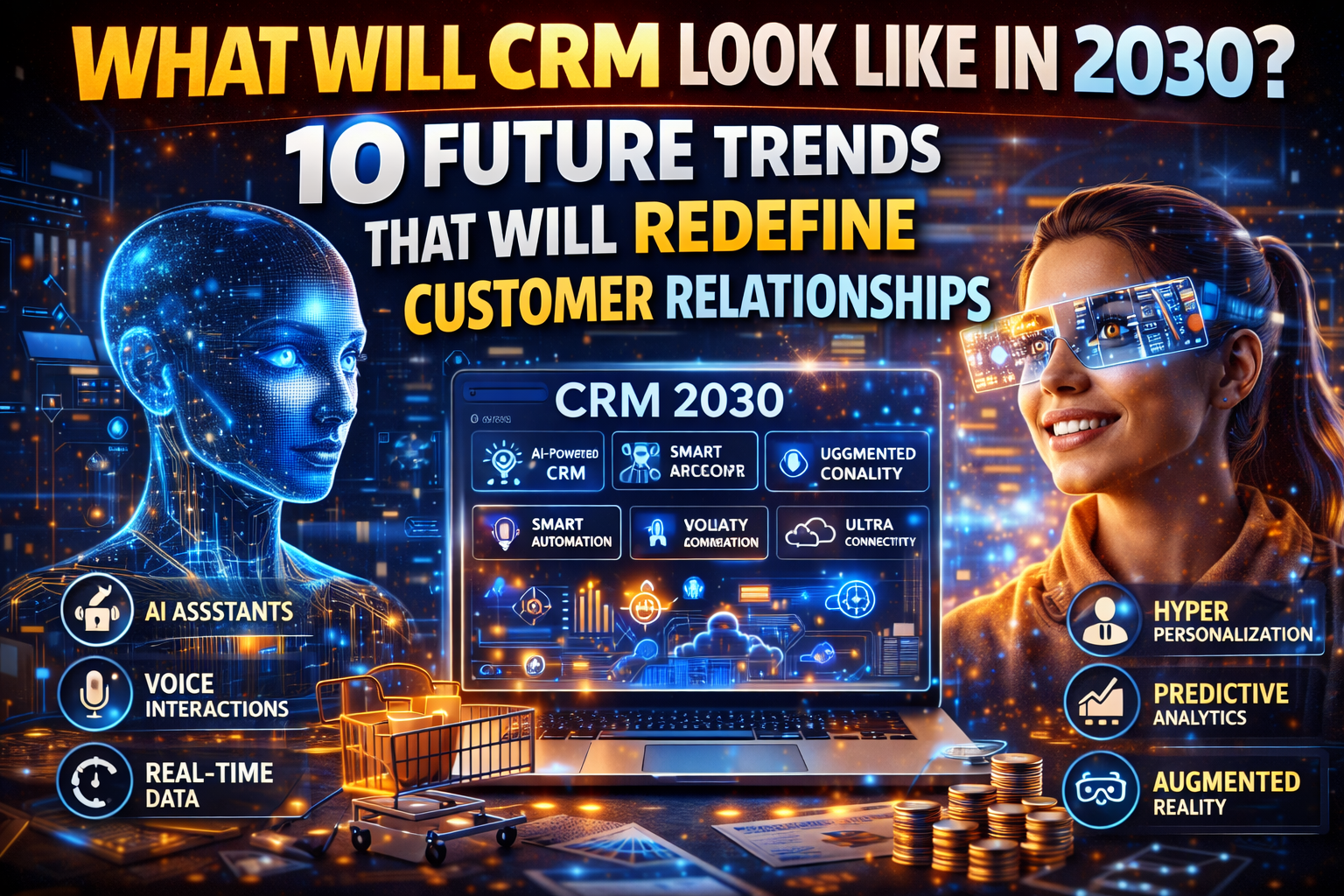
What will CRM look like in 2030? Discover future trends, AI innovations, and how CRM systems will transform customer relationships globally in the next decade.
Table of Contents
Introduction
Customer Relationship Management (CRM) has evolved dramatically over the past decade—from simple contact databases to intelligent, AI-powered platforms. But the real transformation is just beginning.
So the big question is: What Will CRM Look Like in 2030?
By 2030, CRM systems will no longer be just tools—they will act as intelligent, autonomous growth engines that predict, decide, and act on behalf of businesses.
In this blog, we explore the future of CRM, emerging technologies, and how businesses can prepare for the next wave of innovation.
The Evolution of CRM: From Data Storage to Intelligence
Initially, CRM systems were designed to store customer data and track interactions. Over time, they evolved to include:
- Automation
- Analytics
- Omnichannel communication
Today, CRM platforms are powered by AI and predictive analytics.
👉 Learn more about CRM basics:
https://www.salesforce.com/crm/what-is-crm/
👉 Explore digital transformation trends:
https://www.mckinsey.com/capabilities/mckinsey-digital/our-insights
Why CRM is Rapidly Changing
Several global shifts are driving CRM evolution:
- Explosion of customer data
- Rise of AI and machine learning
- Demand for hyper-personalization
- Privacy and data regulations
- Digital-first customer journeys
These factors are shaping what CRM will become by 2030.
10 Powerful Predictions: What Will CRM Look Like in 2030?
1. Fully Autonomous CRM Systems
By 2030, CRM systems will operate with minimal human intervention.
They will:
- Identify leads
- Nurture prospects
- Close deals automatically
AI agents will handle entire customer journeys.
👉 Learn about AI in CRM:
https://www.oracle.com/cx/what-is-crm/ai-in-crm/
2. Hyper-Personalization at Scale
CRM systems will deliver one-to-one personalization for millions of users simultaneously.
This includes:
- Real-time product recommendations
- Dynamic pricing
- Personalized content experiences
👉 Explore personalization strategies:
https://www.mckinsey.com/capabilities/growth-marketing-and-sales/our-insights
3. Predictive and Prescriptive Intelligence
CRM will not just predict behavior—it will recommend actions.
For example:
- Suggest the best time to contact a customer
- Recommend offers based on intent
- Automatically trigger campaigns
👉 Learn about predictive analytics:
https://www.ibm.com/topics/predictive-analytics
4. Voice and Conversational CRM
CRM interfaces will shift from dashboards to conversations.
Users will interact with CRM through:
- Voice assistants
- Chat interfaces
- Natural language commands
Example:
“Show me high-value leads this week.”
5. Emotion AI and Sentiment Analysis
CRM systems will understand customer emotions using:
- Voice tone analysis
- Facial recognition
- Text sentiment
This will enable empathetic customer interactions.
6. Integration with Web3 and Decentralized Data
By 2030, customers may own their data through decentralized systems.
CRM platforms will:
- Access permission-based data
- Ensure transparency
- Build trust through blockchain
👉 Learn about Web3 concepts:
https://ethereum.org/en/web3/
7. Real-Time Decision Engines
CRM systems will make instant decisions based on live data.
This includes:
- Real-time offers
- Instant support responses
- Dynamic marketing campaigns
👉 Explore real-time analytics:
https://cloud.google.com/solutions/real-time-analytics
8. Unified Customer Data Platforms (CDPs)
CRM and CDPs will merge into a single system.
This unified platform will:
- Combine data from all touchpoints
- Provide a 360-degree customer view
- Enable seamless experiences
9. Augmented Reality (AR) and Virtual CRM Experiences
Customer interactions will move beyond screens.
CRM will integrate with:
- AR shopping experiences
- Virtual showrooms
- Immersive customer engagement
10. Ethical and Privacy-First CRM
With increasing regulations, CRM systems will prioritize:
- Data security
- User consent
- Transparent data usage
👉 Learn about data privacy:
https://gdpr.eu/what-is-gdpr/
Key Technologies Shaping CRM in 2030
1. Artificial Intelligence (AI)
Core engine driving automation and predictions.
2. Machine Learning (ML)
Continuous improvement of customer insights.
3. Big Data
Handling massive volumes of customer information.
4. Blockchain
Ensuring secure and transparent data management.
5. Internet of Things (IoT)
Collecting real-time data from connected devices.
👉 Explore IoT basics:
https://www.ibm.com/topics/internet-of-things
Challenges Businesses Must Prepare For
While the future of CRM is exciting, it comes with challenges:
1. Data Privacy Regulations
Stricter global laws will impact data usage.
2. Technology Complexity
Advanced systems require skilled implementation.
3. High Costs
Cutting-edge CRM solutions may be expensive.
4. Change Management
Adapting to new systems and workflows will be crucial.
How to Prepare for CRM in 2030
To stay ahead, businesses should:
- Invest in AI-driven CRM tools
- Focus on data quality and governance
- Build customer-centric strategies
- Train teams on emerging technologies
- Prioritize privacy and trust
Conclusion
So, What Will CRM Look Like in 2030?
It will be:
- Intelligent
- Autonomous
- Predictive
- Personalized
- Privacy-focused
CRM will evolve from a support tool into a strategic powerhouse that drives growth, enhances customer experiences, and automates decision-making.
Businesses that embrace this transformation early will not just survive—they will lead.
The future of CRM is not about managing customers—it’s about understanding, predicting, and serving them before they even ask.
Scale your sales without the burnout. Learn how Conversational AI in CRM automates lead qualification in live chat to deliver sales-ready prospects instantly.
