
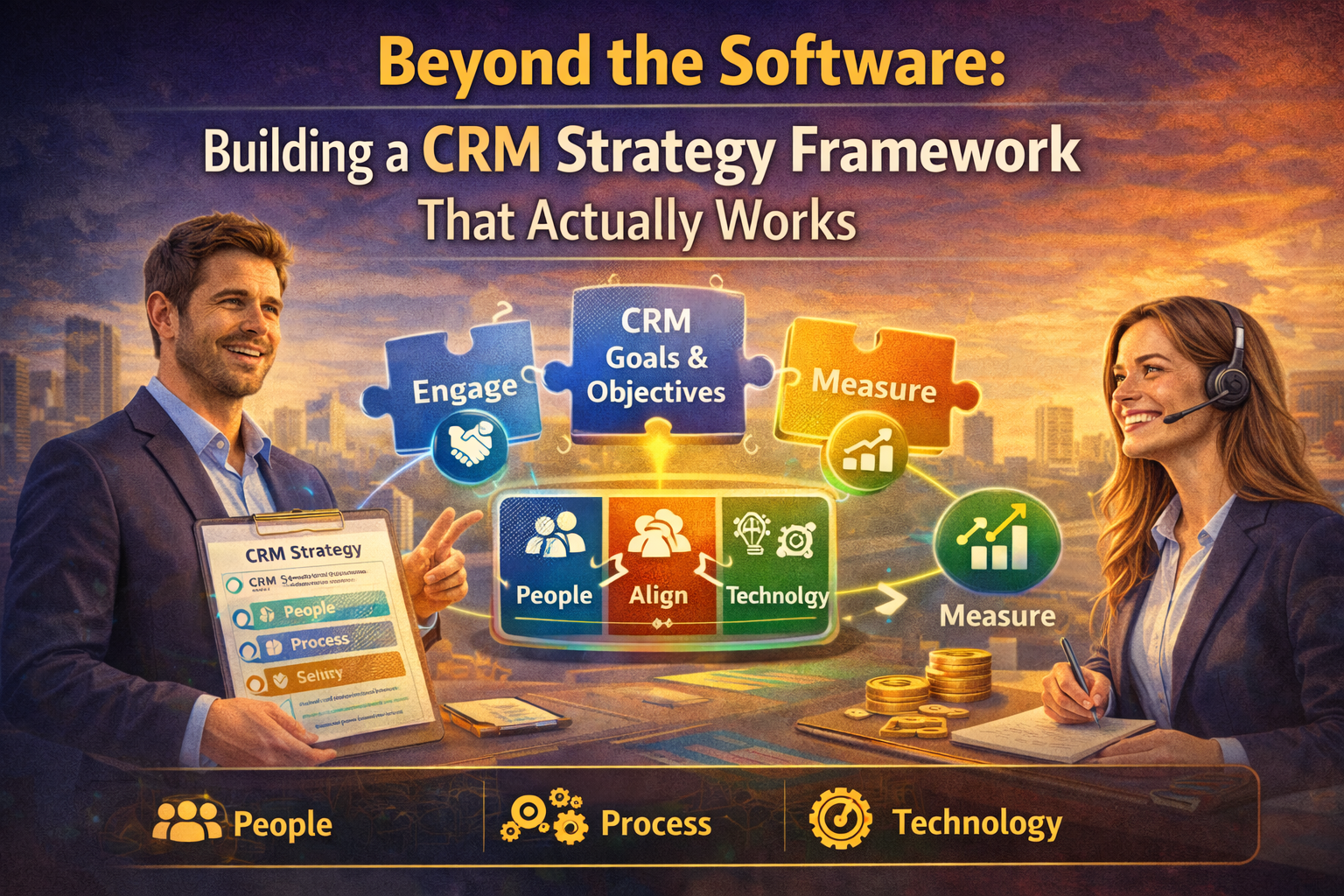
Stop wasting money on expensive tools. Learn how to build a winning CRM Strategy Framework from scratch to align your team and boost customer loyalty.
Table of Contents
I have a confession to make: I’ve seen more companies fail because of their CRM than I have seen them succeed. Now, before you close this tab, let me clarify. The failure isn’t usually the software’s fault. It’s because most leadership teams treat a CRM like a magic wand—they buy a subscription, dump their messy data into it, and expect their revenue to double overnight. It never works that way. A CRM is a tool, but without a solid CRM Strategy Framework, it’s just an expensive digital filing cabinet that your sales team will probably hate using.
If you’re feeling overwhelmed by a clunky system or you’re starting from zero, take a breath. The goal isn’t to find the “perfect” software; it’s to build a blueprint for how you want to treat your customers. We’re talking about a fundamental shift in how your business breathes. In this guide, I’m going to walk you through how to construct a CRM Strategy Framework from the ground up—one that prioritizes people over pixels and results over reports.
Why Most Organizations Get It Backwards
The most common mistake is starting with the “How” instead of the “Why.” You see a shiny ad for Salesforce or HubSpot and think, “We need that.” But you haven’t decided what you’re trying to achieve. Are you struggling with lead conversion? Is your customer churn rate through the roof? Or is your internal communication so fractured that your account managers have no idea what your sales reps promised?
A winning CRM Strategy Framework acts as the connective tissue between your departments. It ensures that your marketing, sales, and support teams aren’t just working in the same building, but are actually singing from the same sheet music. Without this alignment, you’re just paying for a database that grows more confusing every single day.
Phase 1: Define Your North Star
Before you touch a single setting in a dashboard, you need to define your objectives. A CRM Strategy Framework needs a goal. For some, it’s about shortening the sales cycle. For others, it’s about increasing the lifetime value of a customer through better up-selling.
- Audit Your Current State: Where is your data currently living? (Hint: It’s probably in three different spreadsheets and one person’s head).
- Identify the Pain Points: What is the one thing that makes your sales team want to pull their hair out?
- Set Measurable KPIs: If you can’t measure it, you can’t manage it. Decide now if success looks like a 10% increase in retention or a 20% faster response time.
Phase 2: Mapping the Customer Journey
Your customers don’t experience your brand in silos, so your software shouldn’t behave as if they do. A core part of your CRM Strategy Framework involves mapping out every single touchpoint. From the moment someone clicks an ad to the third year they’ve been a loyal subscriber, you need to know what they need at every step.
If your CRM doesn’t reflect the reality of how people buy from you, your team will find workarounds. And workarounds are the death of clean data. When you build your CRM Strategy Framework, you must ensure that the “stages” in your pipeline match the actual psychological journey of your buyer.
Phase 3: The People and the Process
I’ve said it before and I’ll say it again: a CRM is a cultural shift, not just a technical one. You can have the best CRM Strategy Framework in the world, but if your top sales rep refuses to log their calls, the system fails. You need buy-in from the ground up.
- Assign a CRM Champion: You need one person who “owns” the system. This isn’t an IT role; it’s a process role.
- Standardize Data Entry: If one person enters a phone number as (123) 456-7890 and another uses 123.456.7890, your reporting will eventually break.
- Training is Non-Negotiable: Don’t just give them a login and a “Good luck!” Hold workshops. Show them how the CRM Strategy Framework makes their lives easier, not harder.
Phase 4: Choosing the Right Tech Stack
Only after you have your goals, your journey, and your processes in place should you go shopping. When looking at software to fit your CRM Strategy Framework, look for flexibility. Your business will be different in two years; will the software grow with you or will it become a straightjacket?
Integration is the name of the game here. Your CRM should talk to your email marketing tool, your accounting software, and your help desk. According to the Customer Relationship Management entry on Wikipedia, the primary goal is to improve business relationships. This is impossible if your data is trapped in five different “black boxes.”
Phase 5: Implementation and Data Migration
This is where the rubber meets the road—and where things usually get messy. Moving data is like moving houses. You don’t want to pack up all your old trash and move it to the new place. A successful CRM Strategy Framework requires a deep “data scrub” before you migrate.
If you have 5,000 leads from 2014 that haven’t opened an email in six years, leave them behind. Focus on quality over quantity. Once the data is in, test your workflows. Does the automated follow-up actually send? Does the notification go to the right rep? Your CRM Strategy Framework is only as good as the execution of these small, technical details.
Phase 6: Continuous Iteration and Optimization
A CRM Strategy Framework isn’t a “set it and forget it” project. It’s a living document. Every quarter, you should be looking at your reports and asking: “Is this actually helping us?”
If a specific stage in your sales funnel has a 90% drop-off rate, the data is telling you something. Maybe your follow-up is too slow, or maybe your qualifying questions are too aggressive. Use the insights gathered through your CRM Strategy Framework to pivot. The companies that win are the ones that are agile enough to change their tactics based on what the data is actually saying, not what they wish it was saying.
Leveraging Data for Personalization
We live in an era where consumers expect you to know them. If I’ve been a customer for five years and I get a “New Customer Discount” email, I’m annoyed. It shows you aren’t paying attention. A robust CRM Strategy Framework allows for the kind of segmentation that makes your marketing feel like a conversation rather than a broadcast.
By using the data in your system, you can send the right message at the right time. This is the “secret sauce” of high-growth enterprises. They use their CRM Strategy Framework to identify their “VIP” customers and treat them accordingly, while nurturing cold leads without burning out their sales team.
Accountability and Reporting
If it’s not in the CRM, it didn’t happen. This needs to be the mantra of your office. A CRM Strategy Framework fails when people start keeping their own “side” notes. You need a single source of truth.
Managers should use the CRM for their one-on-one meetings. Instead of asking “What are you working on?”, they should already see it in the dashboard. This shifts the conversation from “What happened?” to “How can I help you close this?” This shift is only possible when the CRM Strategy Framework is fully integrated into the daily habits of the team. For more on the psychological impact of management styles on sales performance, check out the resources at the Harvard Business Review.
FAQ Section
1. How long does it take to build a CRM Strategy Framework? The initial blueprint can be done in a few weeks, but the full implementation and cultural adoption usually take 3 to 6 months. It’s a marathon, not a sprint. If you rush the process, you’ll likely have to redo it all in a year.
2. Is a CRM only for big companies? Absolutely not. In fact, small companies need a CRM Strategy Framework even more because they have fewer resources to waste. Having a system in place early allows you to scale without the “growing pains” of lost data and missed leads.
3. What is the most important part of the framework? The “Process.” You can have the best strategy and the best software, but if you don’t have a defined process for how data enters and moves through the system, it will eventually become a mess.
4. How much should I spend on a CRM? It varies wildly, but your budget should include more than just the software subscription. Factor in the cost of training, data migration, and potentially a consultant to help you set up your CRM Strategy Framework correctly the first time.
5. How do I know if my CRM strategy is working? Look at your churn rate and your customer lifetime value. If your CRM Strategy Framework is effective, you should see those numbers moving in the right direction. Also, watch your team’s adoption rate—if they are actually using it without being nagged, that’s a huge win.
Conclusion
At the end of the day, a CRM shouldn’t feel like a chore; it should feel like a superpower. It gives your team the ability to remember every detail about every customer, even as you scale to thousands of accounts. But that superpower only comes from having a disciplined CRM Strategy Framework in place before you ever log in.
