
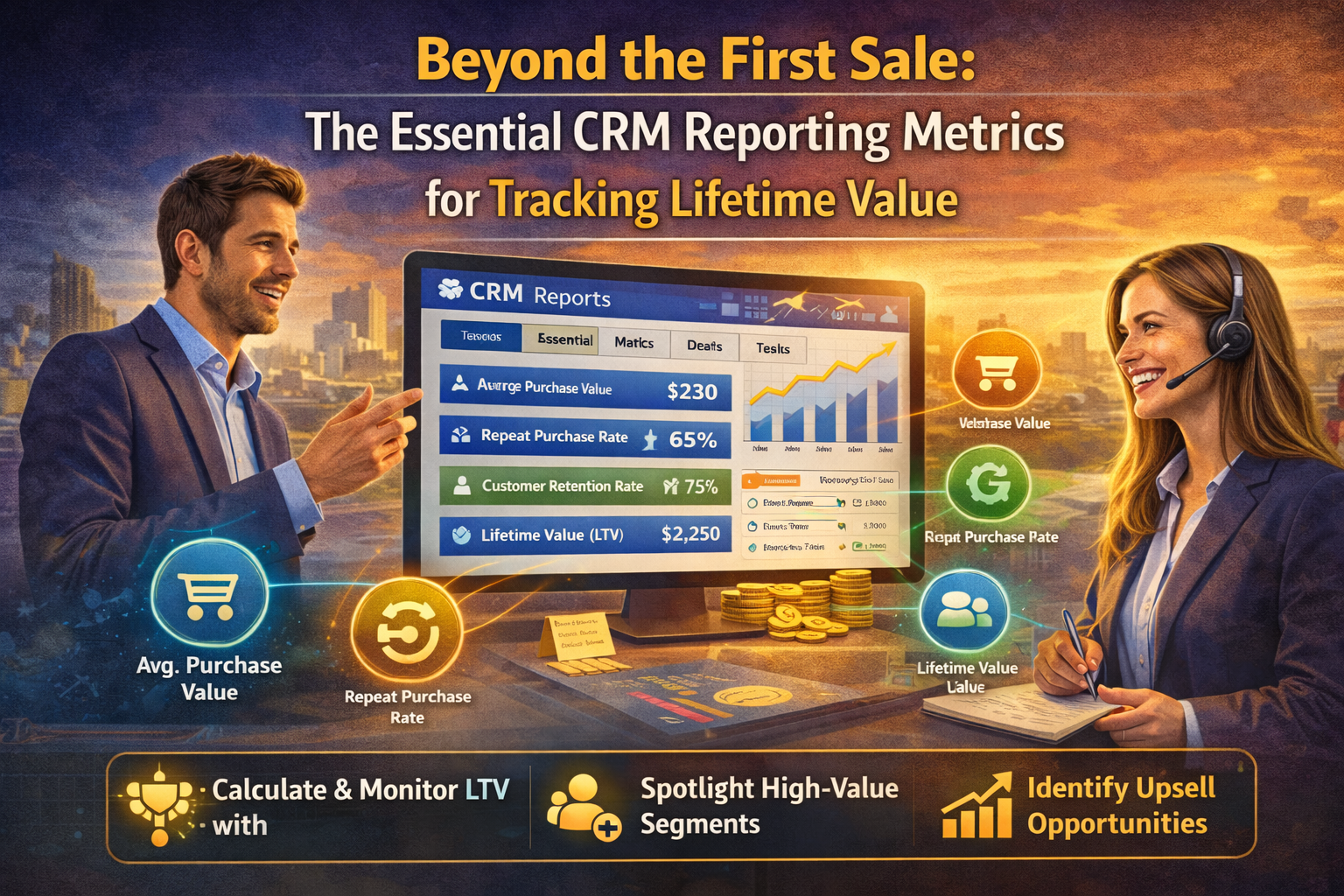
Stop obsessing over one-time sales. Master the CRM Reporting Metrics that reveal true Customer Lifetime Value (CLV) and drive sustainable business growth.
Table of Contents
I’ve sat through enough sales meetings to know that everyone loves the sound of a closing bell. There is an undeniable rush when a new lead finally signs on the dotted line. But if you are only looking at the initial “win,” you are missing about 80% of the story. In the long run, the health of your business isn’t determined by how many doors you open; it’s determined by how many people decide to stay inside.
To really understand if your company is thriving or just surviving, you have to look deeper into your data. This is where CRM Reporting Metrics move from being “nice-to-have” charts to being the literal pulse of your organization. If you aren’t tracking Customer Lifetime Value (CLV), you are essentially flying a plane with half the dashboard blacked out. You know your altitude for the moment, but you have no idea if you have enough fuel to reach your destination.
The Shift from Transactional to Relational
For years, the gold standard of success was the “Conversion Rate.” How many people did we talk to, and how many bought something? While that matters, it’s a very transactional way of looking at the world. Modern business—especially in the subscription and service sectors—is relational.
When you set up your CRM Reporting Metrics, you need to shift your focus toward the long game. A customer who spends $100 today but never returns is actually less valuable than a customer who spends $20 every month for three years. The cost of acquiring that second customer is likely lower over time, and their advocacy is worth its weight in gold.
The Core Metric: Calculating Customer Lifetime Value (CLV)
Before we get into the weeds, we have to define the “North Star.” Customer Lifetime Value is the total revenue you can expect from a single customer account throughout your business relationship.
Tracking this through CRM Reporting Metrics allows you to see which segments of your audience are actually worth your marketing spend. If you find that customers from LinkedIn have a 40% higher CLV than those from Facebook, you know exactly where to shift your budget. It takes the guesswork out of your growth strategy.
- Average Purchase Value: What is the mean price of a transaction?
- Purchase Frequency: How often does a typical customer return in a year?
- Customer Lifespan: How many years do they stay active before they churn?
Why Churn Rate is the Ultimate Truth-Teller
You can’t talk about lifetime value without talking about the “leak” in the bucket. Churn rate—the percentage of customers who stop doing business with you over a given period—is one of the most sobering CRM Reporting Metrics you will ever track.
I’ve seen companies spend millions on aggressive acquisition only to wonder why their revenue is flat. It’s because they are losing people out the back door just as fast as they are bringing them in. A high churn rate is usually a signal that your product-market fit is off or your customer success team is overwhelmed. By monitoring this closely, you can identify “at-risk” accounts before they vanish.
Expansion Revenue: The Hidden Growth Engine
The easiest sale you will ever make is to someone who has already bought from you. This is why “Expansion Revenue”—the revenue generated from existing customers through up-sells, cross-sells, or add-ons—is one of my favorite CRM Reporting Metrics.
If your CLV is stagnant, it might be because you aren’t showing your current fans what else you can do for them. Your CRM should be able to tell you which customers have reached a “maturity” level where they might need a more advanced version of your service.
Customer Acquisition Cost (CAC) vs. Lifetime Value
This is the “Golden Ratio” of business. If it costs you $100 to acquire a customer (CAC), but their lifetime value (CLV) is only $90, you are effectively paying $10 for the privilege of working for them. That is a fast track to bankruptcy.
Ideally, you want your CLV to be at least 3x your CAC. Using CRM Reporting Metrics to track this ratio by lead source or salesperson can be eye-opening. You might find that your “cheapest” leads are actually your most expensive because they churn almost immediately, while your “expensive” leads stay for a decade.
The Importance of Customer Sentiment and NPS
Data isn’t just about dollar signs; it’s about feelings. Integrating Net Promoter Score (NPS) or general satisfaction surveys into your CRM Reporting Metrics gives you a “lead indicator” for future value.
A customer might still be paying you today, but if their last three support tickets were angry and their NPS score is a 3, their lifetime value is about to hit a wall. According to the insights on Customer Success Management, proactive intervention based on sentiment can increase CLV by up to 25%. Don’t wait for the cancellation email to find out they were unhappy.
Tracking Engagement Velocity
How “active” is your customer? In many industries, the time between interactions is a massive predictor of churn or expansion. If a client used to log in five times a week but hasn’t been seen in fourteen days, their “velocity” has dropped.
Setting up CRM Reporting Metrics that flag these changes in behavior allows your account managers to be proactive. A simple “Hey, I noticed you haven’t used the dashboard lately, do you need a refresher?” call can save a high-value account. It’s about using data to be more human, not less.
Time to Profitability (Payback Period)
How long does it take for a customer to pay back the cost of their own acquisition? For some SaaS companies, this can be 6 to 12 months. For a real estate agent, it might be the very first transaction.
When you track this through your CRM Reporting Metrics, you gain a much clearer picture of your cash flow needs. If your payback period is getting longer, you might need to rethink your pricing or find more efficient ways to close deals. It’s a vital reality check for any scaling enterprise.
Referral Revenue and Advocacy
The ultimate sign of a high-value customer is that they bring you more customers. While it’s harder to track perfectly, trying to attribute referral revenue to specific advocates in your CRM Reporting Metrics is worth the effort.
This helps you identify your “VIP” tier. These aren’t just the people who spend the most; they are the people who have the highest “network value.” If you know that Customer A has referred three other high-value clients, their individual CLV is effectively much higher than their own billing suggests. You can find more on the importance of this in the Harvard Business Review’s guide to Customer Management.
Personalizing the Nurture Cycle
If you know a customer’s typical lifecycle—say they usually upgrade after 18 months—you can automate your outreach to hit them at exactly month 17. This isn’t just “good marketing”; it’s smart CRM Reporting Metrics in action.
By analyzing the data of your longest-tenured clients, you can build a “success map” for new ones. You can see the common milestones they hit and the points where they typically struggled. This allows you to provide a much more guided, valuable experience, which naturally extends the lifespan of the relationship.
Identifying Your “Ideal Customer Profile” (ICP)
Not all revenue is created equal. Some clients are “expensive” in terms of support time and emotional energy. By running your CRM Reporting Metrics through the lens of profitability, not just revenue, you can find your true ICP.
You might find that a certain industry or company size has a much higher CLV with a much lower “cost to serve.” Once you have that data, you can stop chasing the “noisy” leads that suck up your time and start focusing on the “quiet” ones that build your legacy.
FAQ Section
1. What is the single most important CRM reporting metric? If I had to pick one, it’s the CLV to CAC ratio. It tells you if your business model is sustainable. If you are spending more to get a customer than they are worth to you over time, nothing else matters—you have to fix that fundamental gap first.
2. How often should I be reviewing my CRM reports? Weekly for tactical adjustments (like sales activity and lead response times) and monthly or quarterly for the big-picture CRM Reporting Metrics like Churn Rate and Lifetime Value. You need enough time to see trends, but you don’t want to wait so long that a problem becomes a disaster.
3. My CRM doesn’t track Lifetime Value automatically. What should I do? Most basic CRMs require a little bit of manual setup or a third-party integration to calculate CLV perfectly. Start by ensuring all your historical sales data is in one place. You might need to use a tool like Power BI or a simple spreadsheet to run the final calculations until you can upgrade your system.
4. Can these metrics apply to a small business or freelancer? Absolutely. In fact, for a freelancer, a single high-value, long-term client can be the difference between a stressful year and a great one. Tracking who stays with you and why is even more important when you have fewer “total” clients to rely on.
5. Does high engagement always mean high lifetime value? Usually, but not always. Sometimes high engagement is a sign of a confused user who is constantly searching for help or hitting roadblocks. Always look at your engagement metrics alongside your support ticket volume to get the full picture.
Conclusion
At the end of the day, your CRM shouldn’t just be a digital phone book; it should be a crystal ball. The data is there, but it’s up to you to pull it out and make it meaningful. By shifting your focus toward CRM Reporting Metrics that track the entire lifecycle of a customer, you stop being a “hunter” who has to find a new meal every single day and start being a “farmer” who builds an estate that produces for years.
