
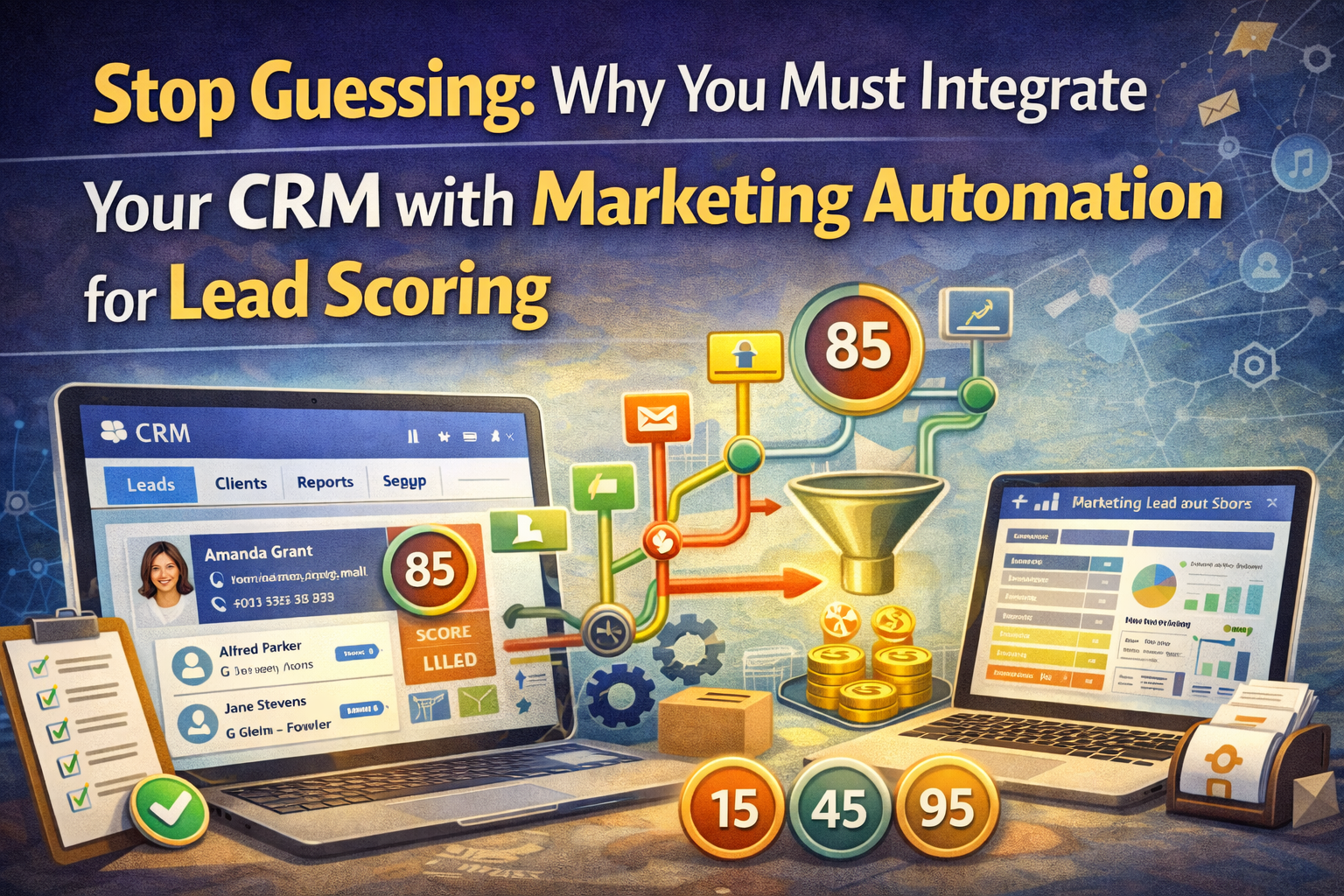
Maximize your sales efficiency. Learn how connecting a CRM with Marketing Automation creates a powerful lead scoring system to identify your hottest prospects.
Table of Contents
I’ve spent countless hours sitting in sales meetings where the energy felt like a low-stakes tug-of-war. The marketing team was proud of the “thousands of leads” they generated from a recent webinar, while the sales reps were rolling their eyes because most of those leads were just college students doing research or competitors snooping around. It’s a classic disconnect. If your sales team is wasting time calling people who aren’t ready to buy, you don’t have a lead problem; you have an organization problem.
The bridge over this gap is the decision to integrate your CRM with Marketing Automation. When these two systems talk to each other, magic happens. You move away from “spray and pray” marketing and start moving toward a surgical approach to sales. Instead of guessing who might be interested, you use real data to score every interaction, ensuring your reps only pick up the phone for the hottest prospects.
The Power of the Unified Tech Stack
A CRM is essentially your digital rolodex and history book; it’s where you store the “who” and the “what” of your sales history. Marketing automation, on the other hand, is the engine that drives engagement through emails, social media, and landing pages. When you operate them as silos, you’re essentially flying with one eye closed.
By connecting your CRM with Marketing Automation, you create a closed-loop system. Information flows back and forth. Marketing can see which leads actually turned into revenue, and Sales can see exactly which whitepapers a lead downloaded before their first call. This context is what transforms a cold call into a warm, informed conversation.
What is Lead Scoring and Why Does It Matter?
Lead scoring is the process of assigning a numerical value to each lead based on their behavior and demographics. It’s how you separate the window shoppers from the serious buyers. Without an integrated CRM with Marketing Automation, lead scoring is usually just a hunch.
With integration, you can assign points for specific actions. For example, a lead might get 5 points for opening an email, 20 points for visiting your pricing page, and 50 points for requesting a demo. Once they hit a certain threshold—let’s say 100 points—the system automatically flags them as a “Sales Ready Lead” (SRL) and pushes them into the CRM for immediate follow-up.
Benefits of Connecting CRM with Marketing Automation
If you’re still on the fence about the technical effort required, consider the impact on your bottom line. Companies that master lead scoring through an integrated CRM with Marketing Automation often see a significant increase in their conversion rates.
- Sales Alignment: Both teams finally agree on what a “good lead” looks like.
- Shortened Sales Cycles: Reps don’t waste time nurturing cold leads; they jump in right when interest is at its peak.
- Personalized Nurturing: You can send different content to a lead with a score of 20 than you would to one with a score of 80.
- Higher ROI: You stop burning your marketing budget on audiences that never convert.
How to Build a Scoring Model That Actually Works
You can’t just flip a switch and expect a perfect score. You need to sit down and decide what behaviors actually indicate a “buying intent.” When you sync your CRM with Marketing Automation, you should look at two types of data: Explicit and Implicit.
Explicit Data (Who they are)
This is the information they give you on a form. Are they a CEO or an intern? Is their company a Fortune 500 or a small local shop? In your CRM with Marketing Automation setup, you might give more points to a “Decision Maker” than to a “Researcher.”
Implicit Data (What they do)
This is the digital body language. If a lead visits your “Contact Us” page, that’s a high-intent signal. If they only read your blog posts about general industry trends, they might just be looking for free information. A robust CRM with Marketing Automation strategy tracks these footprints across your entire digital presence.
The Technical Handshake: Making it Happen
Integration isn’t just about moving names from List A to List B. It’s about data synchronization. You need to ensure that when a lead score changes in the marketing tool, it updates in the CRM in real-time.
Most modern platforms offer native integrations, but you might need to use a tool like Zapier or a custom API to get the specific data points you need. According to the Marketing Automation entry on Wikipedia, the primary goal is to replace manual repetitive tasks with automated processes. By leveraging your CRM with Marketing Automation, you are essentially putting your lead qualification on autopilot.
Real-World Examples: Success in Action
I’ve worked with a SaaS company that was struggling with a 3% close rate. After they spent a month aligning their CRM with Marketing Automation, they realized their sales team was calling everyone who downloaded a basic “Checklist” PDF.
Once they implemented lead scoring, they found that people who watched a 10-minute product video were 5x more likely to buy. They changed their workflow so that only “video viewers” were sent to sales. Their close rate jumped to 12% within a single quarter because the reps were focused on the right people.
Common Pitfalls to Avoid
It’s easy to get over-excited and over-complicate your scoring. If you give points for every single click, everyone will eventually end up with a high score, making the system useless.
- Ignoring Negative Scoring: You should also subtract points. If a lead hasn’t visited your site in 60 days, their score should decay.
- Set It and Forget It: Your CRM with Marketing Automation scoring model needs to be audited every few months. If high-scoring leads aren’t closing, your criteria are wrong.
- Poor Data Hygiene: If your CRM is full of duplicates, your marketing automation tool won’t know which record to update, leading to a fragmented view of the customer.
The Role of Content in Lead Scoring
Content is the “bait” that allows you to measure interest. Without a variety of content—whitepapers, case studies, webinars, and blogs—your CRM with Marketing Automation setup has nothing to track.
Strategic marketers use “Gated Content” to identify high-interest leads. When someone is willing to trade their email address for a specific piece of industry research, they are signaling a level of trust. For more on how to structure these campaigns, the HubSpot Blog offers incredible deep dives into the psychology of lead nurturing and inbound strategies.
Sales and Marketing: The New Power Couple
The old days of Marketing throwing leads “over the fence” to Sales are over. In a modern enterprise, these two departments must operate as a single revenue-generating unit. Utilizing a CRM with Marketing Automation is the glue that holds them together.
When Sales can see the lead score and the activity history, they feel supported by Marketing. When Marketing can see which leads actually closed, they can refine their ads and content to find more people like them. It’s a virtuous cycle that starts with a simple technical integration.
Scaling Your Operations
As your business grows, you simply cannot manually qualify every lead. You will eventually hit a ceiling. An automated CRM with Marketing Automation system allows you to scale your lead generation without scaling your headcount at the same rate.
Whether you are a small startup or a large enterprise, the principles remain the same: identify intent, score it accurately, and act fast. The speed of follow-up is often the deciding factor in who wins the deal. If your CRM with Marketing Automation triggers a notification the second a lead hits a score of 100, your rep can call them while the problem is still fresh in their mind.
FAQ Section
1. Is lead scoring only for big companies? Not at all. Even a small business can benefit from connecting a CRM with Marketing Automation. If you get more than 10 leads a week, you have enough data to start seeing patterns and prioritizing your time better.
2. Which CRM works best with marketing automation? Most “Big 4” CRMs (Salesforce, HubSpot, Dynamics, and Zoho) have excellent native integrations. The “best” one is the one that your team will actually use and that fits your current budget.
3. How long does it take to see results from an integrated CRM with Marketing Automation? Usually, you’ll see a difference in sales productivity within the first 30 to 60 days. It takes a little time to collect enough behavioral data to see if your scoring model is accurate.
4. Can we do lead scoring without a CRM? You can, but it’s like trying to bake a cake without an oven. You’ll have the data in your marketing tool, but your sales team won’t have an easy way to see it or act on it in their daily workflow. A CRM with Marketing Automation is the standard for a reason.
5. What is “score decay”? Score decay is the process of automatically reducing a lead’s score over time if they stop engaging with your content. It ensures that your sales team isn’t calling someone who was interested three months ago but has since moved on.
Conclusion
Integrating your CRM with Marketing Automation is no longer a luxury; it’s a prerequisite for staying competitive. We live in a world where buyers are 70% of the way through their decision-making process before they ever speak to a salesperson. If you aren’t tracking that first 70% through automated lead scoring, you’re missing the most important part of the story.
