
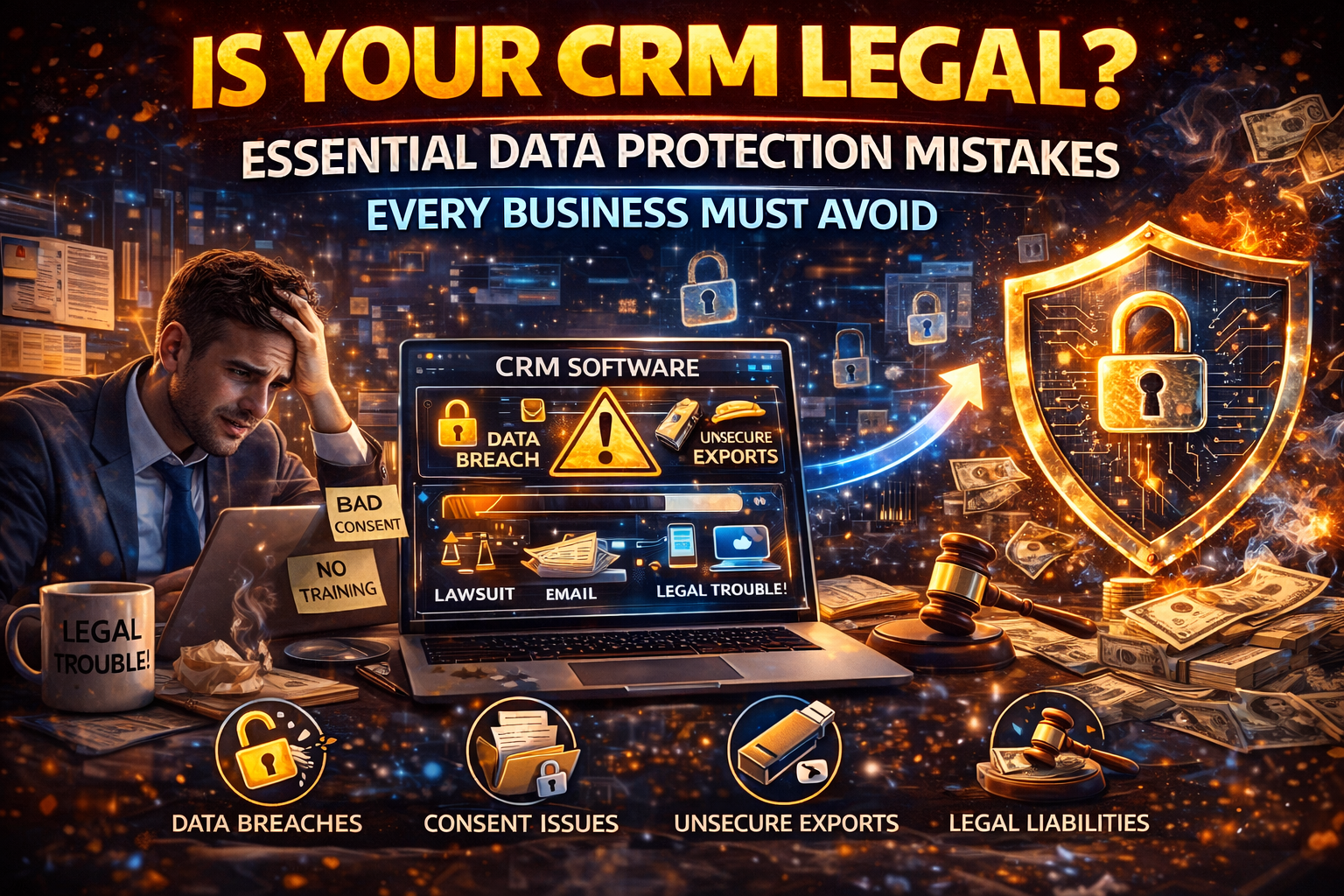
Is your CRM legal? Discover the most common data protection mistakes businesses make and learn how to ensure compliance, protect customer data, and avoid legal risks.
Table of Contents
Introduction
Customer Relationship Management systems have become the backbone of modern businesses. They store valuable customer data, track interactions, and power personalized experiences. But with this power comes responsibility.
A growing concern for businesses worldwide is: Is Your CRM Legal?
With increasing global focus on data privacy and protection, using a CRM without proper safeguards can lead to serious consequences—legal penalties, reputational damage, and loss of customer trust.
In this blog, we’ll explore the most common data protection mistakes businesses make with CRM systems and how to ensure your CRM is compliant, secure, and trustworthy.
Why CRM Compliance Matters More Than Ever
CRM systems handle sensitive customer information such as:
- Names and contact details
- Purchase history
- Communication records
- Behavioral data
Mismanaging this data can result in:
- Data breaches
- Legal fines
- Loss of customer trust
Global regulations are becoming stricter, requiring businesses to take data protection seriously.
👉 Learn about data protection principles:
https://gdpr.eu/what-is-gdpr/
👉 Explore global privacy frameworks:
https://www.oecd.org/privacy/
What Does “Legal CRM” Actually Mean?
A “legal CRM” is one that complies with data protection laws and follows ethical data practices.
This includes:
- Collecting data with consent
- Storing data securely
- Using data transparently
- Allowing users to control their data
👉 Learn about CRM basics:
https://www.salesforce.com/crm/what-is-crm/
Common Data Protection Mistakes to Avoid
Ignoring Customer Consent
One of the biggest mistakes businesses make is collecting and using customer data without proper consent.
Examples:
- Adding users to email lists without permission
- Tracking behavior without disclosure
Solution: Always obtain clear and explicit consent before collecting or using data.
👉 Learn about consent requirements:
https://ico.org.uk/for-organisations/guide-to-data-protection/
Poor Data Security Practices
Weak security measures can expose customer data to breaches.
Common issues:
- Weak passwords
- Lack of encryption
- Unsecured databases
Solution: Implement strong security protocols such as encryption, access controls, and regular audits.
👉 Learn about cybersecurity basics:
https://www.cisa.gov/cybersecurity
Collecting More Data Than Necessary
Many businesses collect excessive data “just in case.”
This increases:
- Risk of breaches
- Compliance complexity
Solution: Follow the principle of data minimization—collect only what you need.
Lack of Data Transparency
Customers have the right to know:
- What data is collected
- How it is used
- Who it is shared with
Failing to provide this information can lead to legal issues.
Solution: Maintain clear privacy policies and communicate openly with users.
Not Allowing Data Access and Deletion
Modern regulations give users rights such as:
- Accessing their data
- Correcting inaccuracies
- Requesting deletion
Ignoring these rights is a major compliance failure.
👉 Learn about user rights:
https://gdpr.eu/gdpr-rights/
Improper Third-Party Integrations
CRM systems often integrate with:
- Marketing tools
- Payment platforms
- Analytics software
If these third parties are not compliant, your business is still responsible.
Solution: Vet all integrations for compliance and security standards.
Failure to Update Data Regularly
Outdated or inaccurate data can lead to:
- Poor decision-making
- Compliance issues
Solution: Regularly review and update your CRM data.
No Data Breach Response Plan
Data breaches can happen—even with strong security.
Without a response plan:
- Damage increases
- Legal risks escalate
Solution: Develop a clear incident response plan and act quickly in case of breaches.
👉 Learn about incident response:
https://www.sans.org/white-papers/incident-response/
Lack of Employee Training
Even the best CRM systems can fail due to human error.
Common issues:
- Sharing sensitive data improperly
- Falling for phishing attacks
Solution: Train employees on data protection best practices.
Key Principles for a Legal CRM System
To ensure your CRM is compliant, follow these principles:
1. Consent-Based Data Collection
Always get permission before collecting data.
2. Data Minimization
Collect only necessary information.
3. Transparency
Be clear about data usage.
4. Security
Protect data with strong measures.
5. Accountability
Take responsibility for data handling.
Benefits of a Compliant CRM
A legal and compliant CRM system offers more than just risk reduction:
Builds Customer Trust
Customers are more likely to engage with transparent businesses.
Enhances Brand Reputation
Compliance shows professionalism and responsibility.
Reduces Legal Risks
Avoid fines and penalties.
Improves Data Quality
Better data leads to better decisions.
Future of CRM and Data Protection
As technology evolves, CRM compliance will become even more important.
AI and Data Ethics
AI-driven CRM systems must ensure ethical data usage.
Stricter Regulations
More global data protection laws are expected.
Privacy-First Business Models
Businesses will prioritize user control and transparency.
How to Make Your CRM Legal Today
Start with these steps:
- Audit your current CRM system
- Update privacy policies
- Implement security measures
- Train your team
- Review third-party integrations
Compliance is not a one-time task—it’s an ongoing process.
Conclusion
So, Is Your CRM Legal?
If you’re unsure, it’s time to take action.
In today’s data-driven world, compliance is not optional—it’s essential. Businesses that prioritize data protection not only avoid legal risks but also build stronger, more trustworthy relationships with their customers.
A legal CRM is not just about following rules—it’s about respecting your customers.
Discover the best CRM Strategies for early-stage startups in 2026. Learn how to manage leads, automate workflows, and scale your business with smart CRM practices.
