
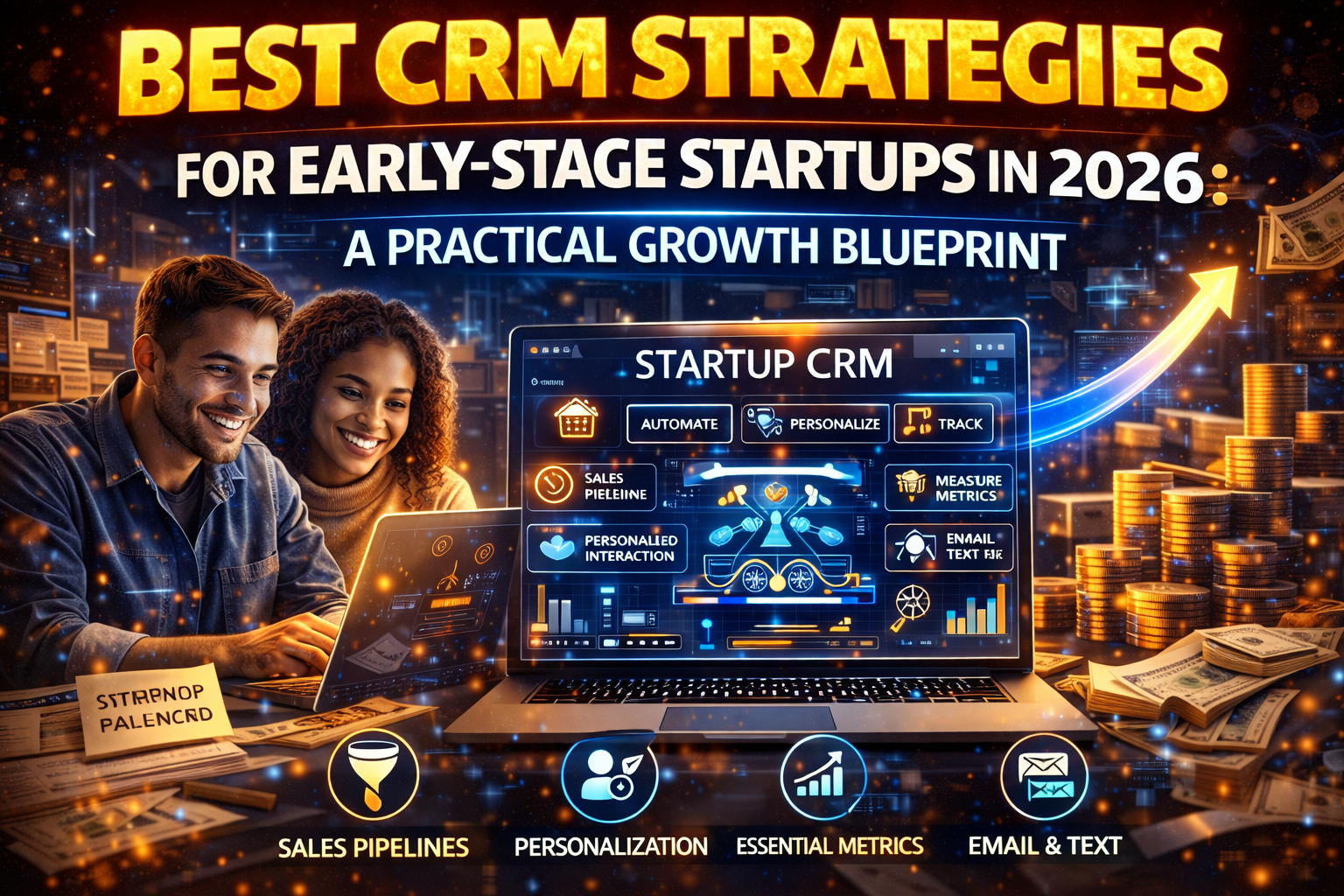
Discover the best CRM Strategies for early-stage startups in 2026. Learn how to manage leads, automate workflows, and scale your business with smart CRM practices.
Table of Contents
Introduction
Building a startup in 2026 is faster, more competitive, and more data-driven than ever before. Early-stage startups often focus heavily on product development and customer acquisition—but without the right systems, growth can quickly become unmanageable.
This is where CRM Strategies come into play.
Customer Relationship Management (CRM) is not just about storing contacts—it’s about building relationships, improving conversions, and creating a scalable growth engine.
In this guide, we’ll explore the best CRM strategies that early-stage startups can implement to stay organized, increase efficiency, and accelerate growth globally.
Why CRM Strategies Matter for Early-Stage Startups
At an early stage, startups typically face:
- Limited resources
- Small teams
- High growth pressure
- Rapidly changing processes
Without structured CRM strategies, startups risk:
- Losing potential customers
- Missing follow-ups
- Poor customer experience
👉 Learn CRM fundamentals:
https://www.salesforce.com/crm/what-is-crm/
👉 Explore CRM for startups:
https://www.hubspot.com/startups
Effective CRM strategies help startups build strong foundations for long-term success.
Start Simple and Focus on Core Needs
One of the biggest mistakes early-stage startups make is overcomplicating their CRM setup.
Instead of using every feature available, focus on:
- Contact management
- Lead tracking
- Basic communication
Simple tools can often deliver better results than complex systems that are difficult to manage.
👉 Explore simple productivity tools:
https://www.notion.so/product
Strategy Insight: Simplicity drives adoption and efficiency.
Define a Clear Customer Journey
Understanding your customer journey is essential for effective CRM strategies.
Map out:
- How customers discover your business
- How they interact with your brand
- What leads them to convert
This helps you:
- Identify key touchpoints
- Improve engagement
- Optimize conversions
👉 Learn about customer journey mapping:
https://www.mckinsey.com/capabilities/growth-marketing-and-sales/our-insights
Build a Structured Lead Management System
A strong lead management process is the backbone of CRM success.
Key steps include:
- Capturing leads from multiple channels
- Categorizing leads based on interest
- Tracking interactions
- Prioritizing high-value prospects
👉 Learn about lead management:
https://www.zendesk.com/blog/lead-management/
This ensures no opportunity is missed.
Leverage Automation Early
Automation is one of the most powerful CRM strategies for startups.
Automate tasks like:
- Email follow-ups
- Lead nurturing sequences
- Task reminders
👉 Explore CRM automation tools:
https://www.hubspot.com/products/crm
Benefit: Saves time and ensures consistency.
Focus on Data Quality from Day One
Clean data is critical for effective CRM strategies.
Best practices:
- Avoid duplicate entries
- Keep information updated
- Standardize data formats
👉 Learn about data management:
https://www.ibm.com/topics/data-management
High-quality data leads to better insights and decisions.
Prioritize Customer Experience
Early-stage startups often focus too much on acquisition and ignore retention.
CRM strategies should include:
- Personalized communication
- Quick responses
- Consistent engagement
👉 Learn about customer experience:
https://www.zendesk.com/blog/customer-experience/
Happy customers are more likely to return and refer others.
Use CRM Analytics for Smarter Decisions
CRM systems provide valuable insights such as:
- Conversion rates
- Customer behavior
- Sales performance
👉 Explore analytics tools:
https://analytics.google.com/
Use these insights to:
- Improve marketing strategies
- Optimize sales processes
- Identify growth opportunities
Choose the Right CRM Tool for Your Stage
Not all CRM tools are suitable for early-stage startups.
Look for:
- Ease of use
- Affordable pricing
- Essential features only
Popular options include:
- HubSpot CRM
- Zoho CRM
- Freshsales
👉 Compare CRM tools:
https://www.g2.com/categories/crm
Strategy Insight: The right tool should simplify your workflow, not complicate it.
Align Sales and Marketing Efforts
Misalignment between sales and marketing can slow down growth.
CRM strategies should ensure:
- Shared data and insights
- Consistent messaging
- Clear communication
This improves lead conversion and customer experience.
Continuously Optimize Your CRM Strategy
CRM is not a one-time setup—it’s an ongoing process.
Regularly:
- Review performance
- Update workflows
- Improve processes
👉 Learn about continuous improvement:
https://hbr.org/topic/continuous-improvement
Startups that adapt quickly gain a competitive edge.
Common Mistakes to Avoid
Even with the best intentions, startups often make mistakes such as:
- Overloading the CRM with unnecessary features
- Ignoring data quality
- Failing to train team members
- Not using analytics
Avoiding these mistakes ensures your CRM strategies remain effective.
Future of CRM Strategies for Startups
Looking ahead, CRM strategies will evolve with:
AI-Driven Insights
Predict customer behavior and automate decisions.
Hyper-Personalization
Deliver tailored experiences at scale.
No-Code CRM Platforms
Simplify customization without technical expertise.
Real-Time Engagement
Instant responses and interactions.
Conclusion
Implementing the right CRM Strategies is essential for early-stage startups aiming to grow efficiently in 2026.
By focusing on:
- Simplicity
- Automation
- Data quality
- Customer experience
startups can build a strong foundation for scalable success.
Remember, CRM is not just a tool—it’s a growth strategy. The earlier you implement it effectively, the faster you can scale your startup.
Discover the top CRM mistakes that are killing startup growth and learn how to fix them. Avoid common pitfalls and use CRM effectively to scale your startup in 2026.
